
For people with asthma and their families. A box at the end covers flare-ups of COPD.
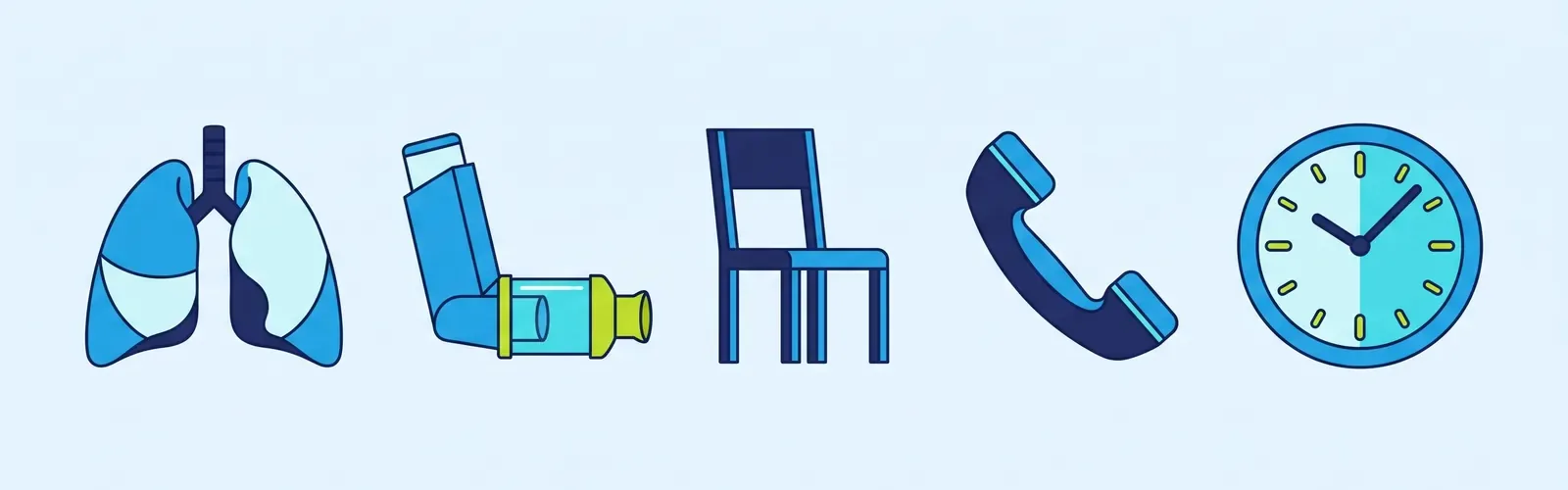
Fill in, then print
You are having an attack if
- Your reliever is not helping, or the relief lasts less than 4 hours
- You are wheezing a lot, your chest is very tight, or you are coughing a lot
- You are too breathless to walk, talk or eat comfortably
- Your peak flow is much lower than your usual
What to do
- Sit upright. Do not lie down. Loosen tight clothing. Try to stay calm.
- Take one puff of your reliever inhaler (salbutamol, usually blue) through the spacer every 30 to 60 seconds, up to 10 puffs. Shake the inhaler before each puff.
- Call 108 if you feel worse at any point, or if you are no better after 10 puffs. If the ambulance will be slow, go by any vehicle to the nearest hospital with an emergency department.
- If help has not arrived after 10 minutes and you are not improving, repeat step 2.
- Still no better? Call 108 again.
No reliever with you? Call 108 at once. No spacer? Use the inhaler on its own. If you use a powder inhaler and cannot breathe in hard enough, tell the ambulance crew.
If your doctor has told you to use a budesonide-formoterol inhaler as your reliever (one inhaler for both prevention and relief): take 1 puff or 1 capsule every 1 to 3 minutes, up to 6. If you feel worse at any point, or are no better after 6, call 108. If help has not come after 10 minutes, take up to 6 more. If you ever need more than the daily number your doctor wrote above, see a doctor that day. For most adults that number is 12 puffs of the 6 microgram strength. A salmeterol combination inhaler is not a reliever. Never use it for an attack.
Call 108 straight away if
- You cannot speak a full sentence
- Your lips or tongue look blue or grey
- You are exhausted, drowsy or confused
- The reliever gives no relief at all
- In asthma, your oxygen level on a finger monitor is below 92 per cent
Call 108 or go to the nearest hospital with an emergency department. Caspian has no intensive care unit or ventilator. While you wait, repeat the reliever as in the steps above.
After an attack
- See a doctor the same day if you managed it at home, and within 2 days if you were treated in a hospital. An attack means your asthma is not controlled.
- Take the full course of steroid tablets if they are prescribed.
- Do not stop your preventer inhaler. Ask us to check your technique.
- Think about what set it off: a cold, smoke, dust, a missed preventer, or a painkiller such as aspirin, ibuprofen or diclofenac.
A flare-up of COPD
- Signs: more breathless than usual, coughing more, more sputum (phlegm), or sputum that has changed colour.
- Use your reliever inhaler through the spacer as your doctor advised.
- If your doctor has given you a rescue pack of steroid tablets or antibiotics, start it as instructed and inform the doctor.
- In COPD the usual oxygen target on a finger monitor is 88 to 92 per cent. Do not turn up home oxygen on your own. Get help if it falls below 88 per cent, or below your own usual level.
- Call 108 if you cannot speak, your chest feels tight or heavy, your lips are pale or blue, or you are confused or drowsy.
For an attack that is settling, or for breathing trouble that is not severe, a doctor is on duty at Caspian at all hours and can give nebulisation and oxygen. For the danger signs above, call 108: do not travel to us first.
Questions about this sheet? Call Caspian Healthcare reception on +91 89193 41154. A doctor is on duty at all hours for problems that are not critical. Caspian has no emergency department: in an emergency call 108.
Where this comes from
- Asthma + Lung UK: asthma attacks
- NHS: asthma attack
- Global Initiative for Asthma: summary guide for asthma management and prevention, 2025
- Asthma + Lung UK: managing COPD flare-ups
- British Thoracic Society: emergency oxygen guideline, summary for prehospital settings
Prepared by Caspian Healthcare from the sources above. Last reviewed October 2026. General information: your own doctor's written instructions come first.