
For anyone with heart failure, and for the family who look after them.
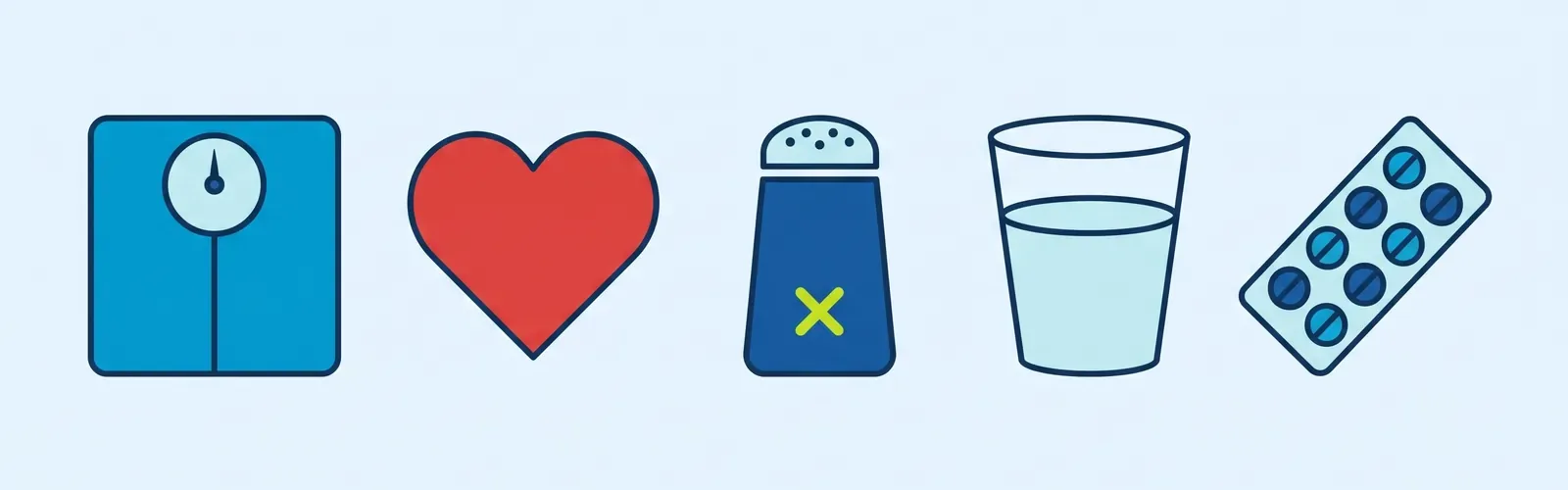
Fill in, then print
Every morning
- Weigh yourself after passing urine and before breakfast, in similar clothes, on the same scale.
- Write the weight down.
- Check your feet and ankles for swelling.
- Take your medicines.
A 14-day weight record is on the printed sheet. Press Print to get it.
| Day 1 | Day 2 | Day 3 | Day 4 | Day 5 | Day 6 | Day 7 |
| Day 8 | Day 9 | Day 10 | Day 11 | Day 12 | Day 13 | Day 14 |
Call your doctor the same day if
- Your weight has gone up by more than 2 kg in 3 days, or by about 1 kg a day for two or more days
- You are more breathless than usual, or need more pillows to sleep
- Swelling of the feet, legs or stomach area is increasing
- You have a new cough at night, or you are more tired than usual
- You feel light-headed, or you are passing much less urine
- Your weight has fallen by 2 kg in 3 days: the diuretic dose may be too high
Fluid builds up in the body before you feel breathless. The scale shows it first.
Salt
- Keep total salt below 5 grams a day: about one level teaspoon, including the salt used in cooking.
- Do not add salt at the table.
- Avoid pickle, papad, namkeen, chutney powders, sauces, salted snacks, and packaged and restaurant food.
- Fizzy antacid salts and tablets that fizz in water are high in sodium. Avoid them.
- Do not use "low sodium" salt substitutes unless your doctor agrees. They contain potassium, which can rise dangerously with heart medicines.
Fluids
- Follow the limit your doctor has written above. Not everyone needs a limit.
- Count everything: water, tea, milk, buttermilk, soup, juice.
- In very hot weather, or with vomiting or loose motions, ask the doctor: you may need more fluid and a smaller diuretic dose for a few days.
Medicines
- Do not stop or skip heart medicines, even when you feel well.
- Take the tablet that makes you pass urine (the diuretic) in the morning. If there is a second dose, take it in the early afternoon, so that sleep is not disturbed.
- Avoid painkillers such as ibuprofen and diclofenac. They hold salt and water in the body and harm the kidneys. Paracetamol is the safer choice.
- Tell every doctor and chemist that you have heart failure before taking any new medicine, including cold remedies and steroids.
Living well
- Walk or stay active every day, as much as is comfortable. Rest when breathless.
- No smoking or tobacco. Keep alcohol to a minimum, or none if your doctor says so.
- Take the influenza vaccine every year and the pneumococcal vaccine once.
Emergency
- Severe breathlessness at rest, or you cannot speak a full sentence
- Chest pain or pressure
- Coughing up pink, frothy sputum
- Loss of consciousness, or lips turning blue
Call 108 or go to the nearest hospital with a cardiac emergency service. Caspian has no cath lab, intensive care unit or emergency department.
Questions about this sheet? Call Caspian Healthcare reception on +91 89193 41154. A doctor is on duty at all hours for problems that are not critical. Caspian has no emergency department: in an emergency call 108.
Where this comes from
- European Society of Cardiology: guidelines for the diagnosis and treatment of acute and chronic heart failure, 2021
- Heart Failure Association of the ESC: dietary sodium and fluid intake in heart failure, clinical consensus statement, 2024
- American Heart Association: lifestyle changes for heart failure
- Heart Failure Matters (Heart Failure Association of the ESC): warning signs
- Heart Online, Australia: potentially harmful drugs to avoid in heart failure
Prepared by Caspian Healthcare from the sources above. Last reviewed October 2026. General information: your own doctor's written instructions come first.