Read your own report here
Upload the lab’s PDF or a photo of each page. Each value you get back is set against the ranges explained on this page. Nothing leaves your phone.
HbA1c, and what it is in real numbers
HbA1c is a percentage, which is why almost nobody has any feel for it. Put your number in and it converts to the average glucose it represents, the units you actually recognise from a glucometer.
Nothing you type here is saved or sent anywhere. The arithmetic happens on your own phone.
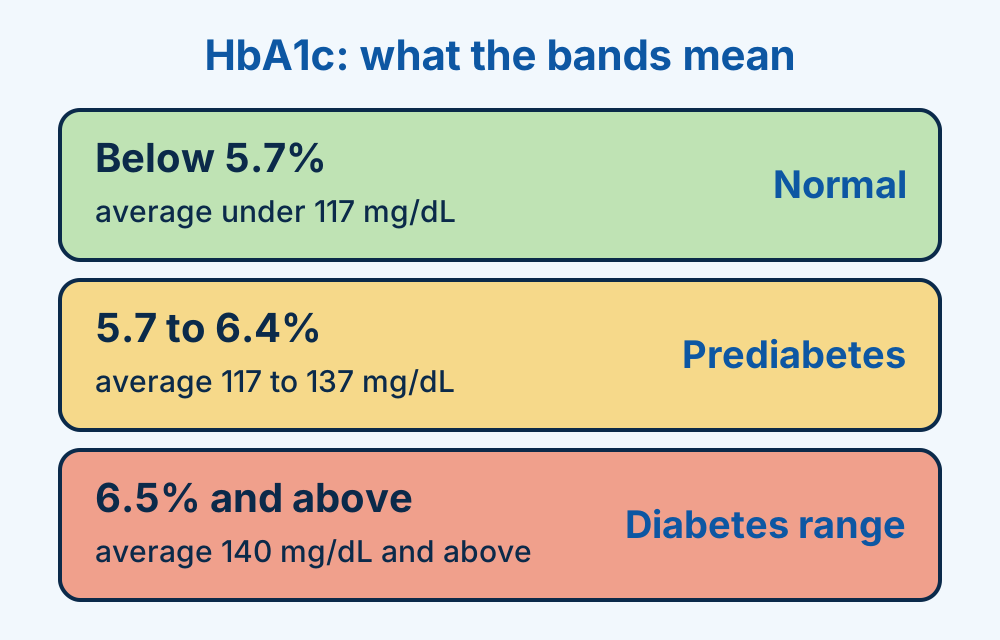
What the bands mean
| HbA1c | Average glucose | What it is called |
|---|---|---|
| Below 5.7% | under 117 mg/dL | Normal |
| 5.7–6.4% | 117–137 mg/dL | Prediabetes. The stage where the work is preventing the diagnosis rather than treating it. |
| 6.5% and above | 140 mg/dL and above | Diabetes range, on two occasions or with symptoms. |
Three things about HbA1c nobody tells you
It is a three-month average, weighted to the last month. The fortnight before the test counts more than the fortnight after your last visit. Which is why the number sometimes improves without anything real having changed.
An average hides the swings. A steady 150 and a line bouncing between 60 and 250 can produce the same HbA1c and are not the same illness. This is exactly what a glucose sensor shows and HbA1c cannot.
It can be wrong if your haemoglobin is unusual. Iron deficiency anaemia, thalassaemia trait, other haemoglobin variants, recent blood loss, recent transfusion, kidney disease and pregnancy all distort HbA1c, some upwards, some downwards. Thalassaemia trait is not rare in this part of the country. If your HbA1c and your sugar readings keep disagreeing, tell us; the answer is often in the haemoglobin, not the glucose.
Sugar readings
| Test | Normal | Prediabetes | Diabetes range |
|---|---|---|---|
| Fasting glucose 8 hours, water only | under 100 | 100–125 | 126 and above |
| Two hours after food | under 140 | 140–199 | 200 and above |
| Random glucose | Not applicable | Not applicable | 200 and above with symptoms |
All values mg/dL. A single abnormal reading is not a diagnosis; it is a reason to repeat the test.
Cholesterol and the lipid profile
Four numbers, and the one most people look at is the least useful.
- LDL: the one that matters. Under 100 mg/dL as a general aim; under 70 if you have diabetes with other risk, or established heart disease. Your own target depends on your risk, not on the lab's column.
- HDL: higher is better. Above 40 in men, above 50 in women.
- Triglycerides: under 150. This is the one that moves fastest with alcohol, sugar, refined carbohydrate and uncontrolled diabetes, and the one that improves quickest when those change.
- Total cholesterol: the number everyone reads first and the least informative of the four, because it adds the good to the bad.
Ask for non-HDL cholesterol if it is not printed: total minus HDL. In someone with diabetes or high triglycerides it predicts risk better than LDL alone, and it does not need you to be fasting.
Liver function, and fatty liver
SGPT (ALT) and SGOT (AST) are enzymes that leak from liver cells. Mildly raised values are extremely common and, in this clinic, are most often fatty liver rather than anything alarming.
Fatty liver is the finding people are told about and then told nothing further about. It matters because it travels with insulin resistance, and because it is one of the few things on a report that genuinely reverses. Weight, alcohol, sugar and the underlying metabolic picture are what move it, not a liver tonic.
Bilirubin raised on its own with normal enzymes is often Gilbert's syndrome, a harmless inherited variant that shows up when you have been fasting or unwell.
Thyroid
TSH is the screening test, roughly 0.4–4.0 mIU/L in most laboratories. Counter-intuitively, a high TSH means an underactive thyroid.
One abnormal TSH is not a diagnosis. It moves with acute illness, with the time of day, and in pregnancy, where the target range is different and tighter. Repeat it before starting anything, with free T4 alongside.
Kidney
Creatinine on its own is hard to interpret because it depends on muscle mass. eGFR is the number to read: above 90 is normal, and below 60 sustained for three months defines chronic kidney disease.
Urine albumin-to-creatinine ratio is the test that finds diabetic kidney disease early, when it is still treatable, and it is the one most often left off. Under 30 mg/g is normal. If you have diabetes and have never had this done, ask for it.
Vitamin D, B12 and haemoglobin
Vitamin D: under 20 ng/mL is deficiency, 20–29 insufficiency. Deficiency is close to universal in urban India, including in people who are outdoors daily.
Vitamin B12: low levels are common in long-term vegetarians and in people on certain long-term diabetes and acid-reducing medicines. Worth checking if you have tingling or numbness in the feet, because it can look exactly like diabetic nerve damage and is treatable.
Haemoglobin: anaemia is common, frequently iron deficiency, and in women is frequently ignored. It also distorts your HbA1c, which is why we read the two together.
Before you worry about a flagged value
- An H or L next to a number is not a diagnosis. Reference ranges are built so that 5 in every 100 healthy people fall outside them. On a twenty-test panel, someone with nothing wrong will usually have one flag.
- Ranges differ between laboratories. Read the range printed next to your own result, not one from the internet.
- A trend beats a single value. Bring your old reports. Three HbA1c results tell us more than one.
- Almost nothing on a routine report is an emergency. It is a reason for an appointment, not a reason to panic at midnight.
Chest pain, breathlessness at rest, confusion, a severe low sugar, or vomiting with very high sugars and rapid breathing need urgent assessment. Call 108 or go to the nearest hospital with emergency facilities. There is no emergency department here.
Bring the report in. Consultation ₹500, which includes going through it line by line, and includes a diet consultation. Tests are billed separately by our laboratory, Caspian Diagnostic Centre, which publishes its rates and collects samples from home.
Medically reviewed by Dr. Khizer Hussain Junaidy, Diabetologist & Bariatric Physician, Telangana State Medical Council 04937. General information for patients of Caspian Healthcare: your own doctor's advice comes first.