Home › Continuous glucose monitoring › Food and your line
Why the tables do not help you
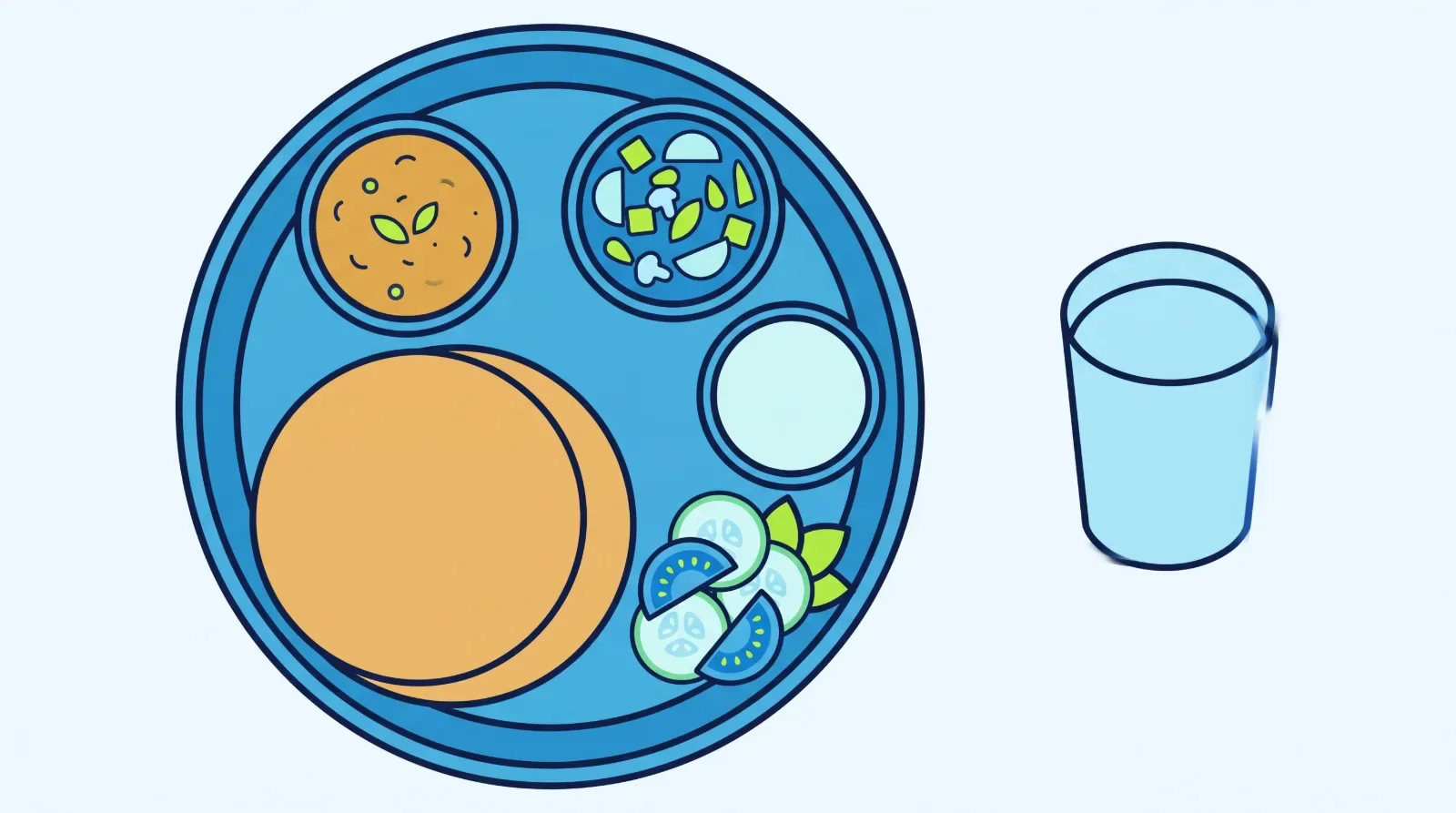
Glycaemic index gets quoted a great deal and explains less than people expect. It is measured in a laboratory, on a portion containing exactly 50 grams of available carbohydrate, given to fasted volunteers, on its own. Nobody eats like that. You ate rice with dal and curry, after a chai, at nine at night, having sat all evening.
A sensor measures what happened to you, on that plate, in that order, on that day. That is why two weeks of your own line is worth more than any list. What follows is what those lines commonly look like, not a promise about yours.
The common plates, and their usual shape
| What you ate | The shape people usually see |
|---|---|
| White rice, dal, sabzi | Fast up, high peak, comes down. Usually the sharpest rise of the day. Peak commonly 45 to 75 minutes after the first mouthful. Portion size moves this more than anything else on the page. |
| Biryani | Delayed and long. The fat and the meat slow the stomach, so the rise is often gentler than plain rice but goes on for hours, sometimes still up at bedtime. People are surprised by this one: it feels heavier and looks flatter early, then will not come down. |
| Two rotis with the same dal | Lower and rounder than the same carbohydrate as rice, for most people. Not flat. Not free. |
| Idli or dosa | Quick. Fermented and soft, eaten early, often on an empty stomach. Two idlis with sambar behave very differently from four with chutney and a coffee. |
| Chai with two sugars | A small sharp spike, 20 to 30 minutes. Trivial once. Four a day is not trivial, and it is the single easiest thing most people change after seeing it. |
| Osmania biscuits with the chai | Higher than the chai alone, and reliably underestimated because two biscuits do not feel like a meal. |
| Fruit, whole | Modest and short for most fruit in a normal portion. Mango and chikoo in season are the ones people ask about, and they do more than an apple. |
| Fruit juice, even fresh | Sharp. Fibre removed, volume easy. Behaves closer to the sugar in chai than to the fruit it came from. |
| Late dinner at 10.30 pm | The overnight line never settles. Same food at 8 pm often looks completely different. This is a timing problem, not a food problem, and it is the commonest finding on a first sensor. |
| Haleem in Ramzan | Slow, heavy and prolonged, and eaten after a whole day without food, so the starting point is unusually low. See the fasting page. |
Every one of these is a tendency across many reports, not a rule. Somebody reading this will have a flat line after rice and a mountain after roti. That person is not doing it wrong; that is the reason we put sensors on people instead of handing them a diet sheet.
The five things that change the shape
Once people can see their own line they stop asking what to cut and start asking what to change. These are the five levers, roughly in order of how much they move the curve.
1. How much
Portion beats every other factor. The same rice at two thirds of the quantity is a visibly different curve. Nothing else on this list is as powerful, and it is the one people least want to hear.
2. What is on the plate alongside it
Carbohydrate on its own rises fastest. The same carbohydrate with protein, vegetables, curd or fat rises slower and lower. Rice with dal and sabzi is a better curve than rice with pickle.
3. The order you eat it in
Vegetables and protein first, starch last, is a small free intervention that shows up on the sensor for many people. It costs nothing and changes no ingredient.
4. What happened in the twenty minutes after
A ten to fifteen minute walk after a meal blunts the peak, often clearly. This is the change most reliably visible on a report, and the one people are most surprised by. Sitting down to television after dinner is a decision the line can see.
5. How it was cooked, and whether it was cooled
Longer cooking and softer starch generally means faster. Rice cooked, cooled and eaten later behaves slightly gentler for some people. This is real but it is the smallest lever here. Do not rearrange your kitchen for it while ignoring the first item.
Nothing on this page is a ban. Rice is what this city eats and advice to stop eating it gets ignored, correctly. The useful question is not whether to eat rice but how much, with what, and what you do in the twenty minutes afterwards. A sensor makes that a matter of evidence instead of argument.
Two weeks is enough to learn your own rules
The most useful way to wear a first sensor is to eat normally for the first week and change nothing. Resist the urge to be good; a fortnight of unusually careful eating tells you about a diet you will not keep.
Then in the second week, test one thing at a time. The same dinner earlier. The same rice with two thirds the quantity. The same meal with a walk after it. One change per day, and the line answers you by bedtime.
Write down what you ate with the time. A report with no food log is a graph of mysteries; the same report with six labelled meals is a plan.
Bring it in and we will read it with you
Consultation ₹500, which includes going through the report and a diet consultation with our dietitian at no separate charge. Sensor prices depend on brand, wear period and stock. Call Caspian Pharmacy on +91 85198 41154. Appointments are on reception, +91 89193 41154.
Dr Khizer sits Mon–Wed, 9 am–1 pm and 3–9 pm, and Thu–Sat, 3–9 pm. Sunday closed.
If you are having a severe low (confused, unable to swallow safely, fitting or unconscious), that is an emergency. Call 108 or go to the nearest hospital with emergency facilities. There is no emergency department here.
Medically reviewed by Dr. Khizer Hussain Junaidy, Diabetologist & Bariatric Physician, Telangana State Medical Council 04937. General information for patients of Caspian Healthcare: your own doctor's advice comes first.