
For anyone who injects insulin with a pen, and for the family member who helps.
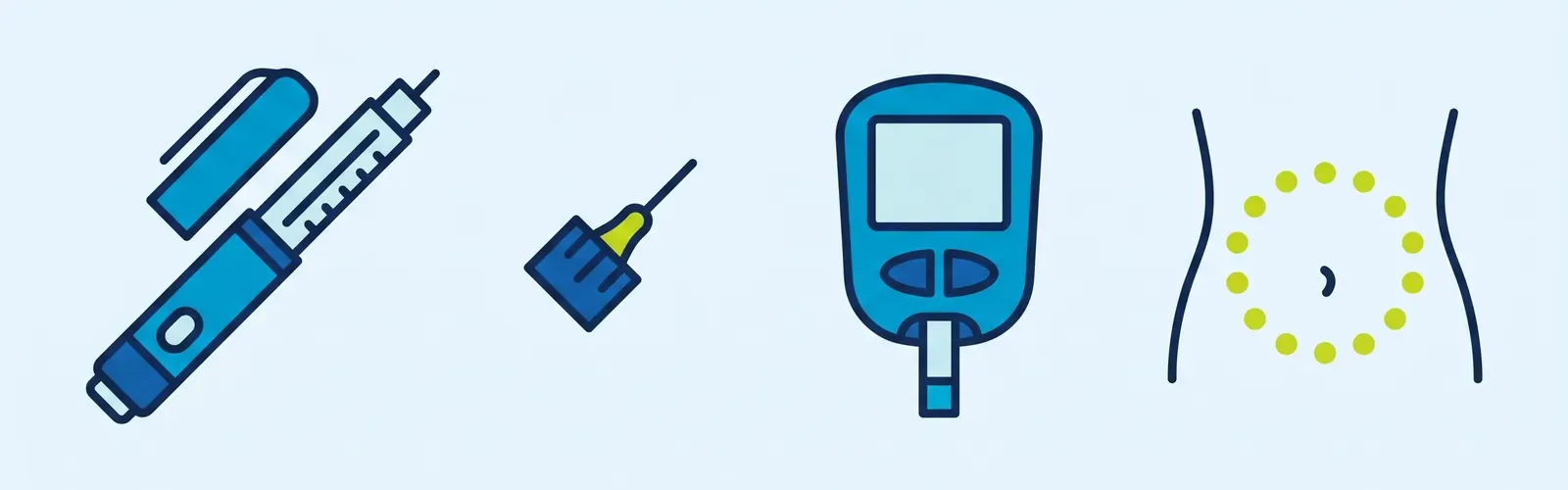
Fill in, then print
Every injection, in this order
- Wash your hands. Check the name of the insulin and the expiry date.
- Cloudy insulin only: roll the pen between your palms 10 times, then tip it up and down 10 times, until it is evenly milky. Do not shake it.
- Fit a new needle.
- Prime: dial 2 units, hold the pen needle-up and press. A drop must appear at the tip. If not, repeat.
- Dial your dose.
- Choose the spot. Push the needle straight in, at a right angle to the skin.
- Press the button fully down, then count slowly to 10 before you pull the needle out.
- Check the dial has returned to 0.
- Unscrew the needle using its large outer cap, and drop it into a closed, hard container.
- Put the pen cap on. Never store the pen with a needle attached.
Where to inject
- Stomach area (abdomen): two finger-widths away from the navel. Fastest and most even absorption.
- Thighs: the upper, outer part.
- Buttocks: the upper, outer part. Slowest absorption.
- Back of the upper arm: difficult to reach alone.
- Not into scars, stretch marks, tattoos, or skin that is swollen or infected. Not through clothing.
Rotate, every time
- Each injection goes one finger-width away from the last one.
- Use one area for a week, then move to the next area.
- Injecting in the same spot again and again produces a rubbery lump under the skin. Insulin from a lump is absorbed poorly and unevenly, and the sugar goes up and down.
- Feel your injection areas with your fingertips once a month.
- If you find a lump, stop injecting into it from today. In normal skin the same dose works more strongly, so test your sugar more often and call the doctor the same day: the dose often needs reducing.
The needle
- A 4 mm pen needle suits almost every adult and child. With it, most people do not need to pinch up the skin.
- Use each needle once. A reused needle is blunt, hurts more, bends, blocks, and causes lumps and wrong doses.
- Never share a pen with another person, even with a new needle.
Storing insulin
- Unopened pens and cartridges: in the fridge, at 2 to 8 °C, on a middle shelf. Never in the freezer and never touching the ice compartment. Insulin that has frozen must be thrown away.
- The pen in use: at room temperature, below 30 °C and out of sunlight, usually for 4 weeks. Check the leaflet for your insulin.
- When the room is hotter than 30 °C: keep the pen in the coolest part of the house, in an insulated cool pouch. Many pens can also stay in the fridge door between doses, but not all. Check the leaflet or ask our pharmacy.
- Never leave insulin in a parked vehicle, near the stove or on a window sill.
- Travelling: carry it in a cool pouch in your hand luggage. It must not touch ice directly.
When to inject
- Rapid-acting insulin: just before the meal, up to 15 minutes before.
- Regular human insulin and human premixed insulin: about 30 minutes before the meal.
- Newer (analogue) premixed insulin: just before the meal. Ask which kind yours is.
- Long-acting (basal) insulin: at the same time every day.
- Missed a dose? Do not take a double dose later. Ask the doctor.
A little bleeding or a bruise now and then does not change how the insulin works. Press gently, do not rub. Spirit is not needed on clean skin at home. If you use it, let it dry fully first. Our educators check injection technique free of charge: ask at reception.
Questions about this sheet? Call Caspian Healthcare reception on +91 89193 41154. A doctor is on duty at all hours for problems that are not critical. Caspian has no emergency department: in an emergency call 108.
Where this comes from
- FITTER Forward: expert recommendations on insulin injection technique, 2025 (summary)
- Forum for Injection Technique India: FITTER India recommendations, addendum 1, 2023
- TREND Diabetes UK: injection technique matters, 2021
- Forum for Injection Technique Canada: recommendations for best practice in injection technique, 2020
- NHS: storing and travelling with insulin
Prepared by Caspian Healthcare from the sources above. Last reviewed October 2026. General information: your own doctor's written instructions come first.