ASTHMA · LUNGS AND BREATHING
Asthma and inhalers: what they do, and why they are not a habit
Many people are afraid of inhalers. They worry they will become dependent on them, or that an inhaler means the asthma is serious. Neither is true.
An inhaler sends a tiny dose of medicine straight into the airways, where it is needed. A tablet sends a much bigger dose round the whole body. That is why inhalers work better, with fewer side effects.
Call 108 now if
- your reliever is not helping, or you need it every few minutes
- you are too breathless to speak or walk
- your lips look blue
- you feel drowsy or confused during an attack
Caspian Healthcare has no emergency department, no ICU and no ventilator. For any of these, call 108 or go straight to a hospital with an emergency department.
Two kinds of inhaler
Reliever
Opens the airways within minutes, for an attack or before exercise. Usually blue. If you need it more than twice a week, your asthma is not controlled.
Preventer
A low dose of steroid that calms the swelling inside the airways. It works slowly, over days to weeks, and must be taken every day, even when you feel well.
Many people now use one combination inhaler for both jobs. Using only a blue reliever, without a preventer, is no longer advised for adults and teenagers with asthma. Your doctor will tell you which plan is yours.
Are inhalers addictive?
No. Inhalers are not habit-forming. People use them for years because asthma is a long-term condition, the same way people with diabetes take their medicine for years. The steroid in a preventer is a very small dose and, at usual doses, rarely causes the side effects of steroid tablets.
Use a spacer
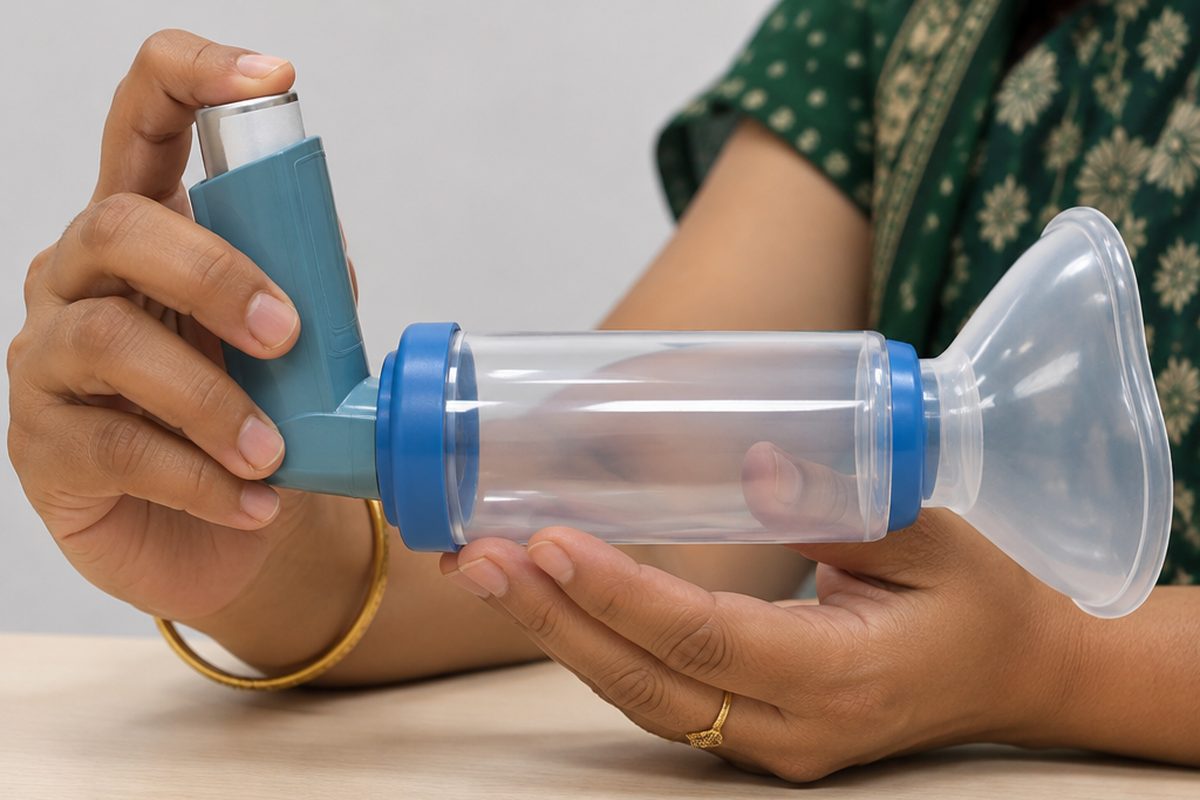
A spacer is a plastic tube that fits on the inhaler. It slows the spray down so more medicine reaches the lungs and less stays in the mouth. With a spacer, an inhaler works as well as a nebuliser in most attacks. Step-by-step sheet: using an inhaler with a spacer.
After a preventer, rinse your mouth and spit. This prevents a sore throat and thrush (a fungal infection in the mouth).
Your asthma is not controlled if
- you use your reliever more than twice a week
- asthma wakes you at night
- it stops you working, playing or exercising
- you have needed steroid tablets or a hospital visit for asthma this year
Any of these means your treatment needs a review, not just more of the reliever. Spirometry measures how open your airways are.
Lung Profile, ₹1,199: spirometry (the breathing test), a chest X-ray and Dr. Sameer’s consultation in one visit, instead of ₹1,550 separately. What it includes.
In an attack
Sit up, stay calm, take your reliever through the spacer as your doctor advised, and call 108 if you are not better within a few minutes or the reliever is not helping. The full sheet: asthma attack: what to do.
See Dr. Sameer at Caspian

Dr. Mohammad Sameer Ahmed, Pulmonologist. MBBS (Kakatiya Medical College), MD Pulmonary Medicine (Gandhi Hospital, Secunderabad). Telangana Medical Council TGMC/FMR/01466.
Monday to Saturday, 8 to 10 pm. Consultation ₹500. Outside these hours a doctor is on duty in the building, day and night.
Common questions
Will I need inhalers all my life?
Not always. Asthma can get better or worse over the years. When it has been well controlled for some months, the doctor may lower the dose. Do not stop the preventer yourself.
Are nebulisers better than inhalers?
For most attacks, an inhaler with a spacer works as well as a nebuliser and is quicker and cheaper. Nebulisers are used for people who cannot use a spacer or for severe attacks.
Are inhalers safe for children?
Yes. Inhalers with a spacer, and a face mask for small children, are the standard treatment for childhood asthma. The doses are small and they are safer than syrups or tablets for the same job.
Read next
Medically reviewed by Dr. Mohammad Sameer Ahmed, Pulmonologist, TGMC/FMR/01466. Last reviewed 13 November 2026. General information for patients of Caspian Healthcare: your own doctor’s advice comes first.