What it actually is
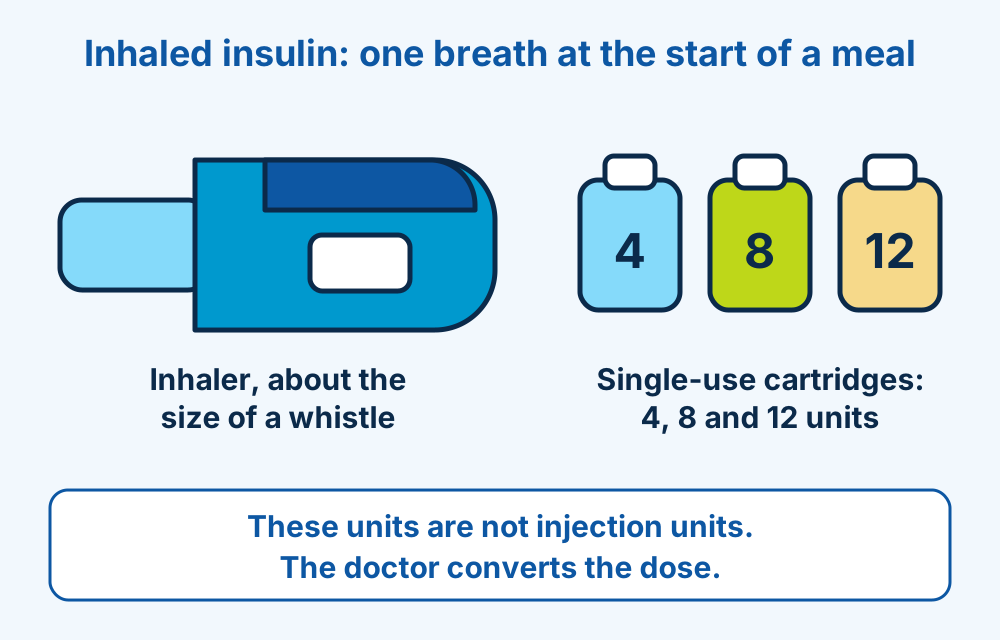
Afrezza is human insulin as a dry powder. It comes in a small single-use cartridge that clicks into a plastic inhaler about the size of a whistle. You take one breath at the start of your meal and that is the dose.
It is not new anywhere except here. It has been used in the United States since 2014. What changed for India is regulatory: the Central Drugs Standard Control Organisation approved it in December 2024, and Cipla began selling it here in December 2025. Before that, patients who had read about it had no lawful way to get it.
The powder dissolves the moment it reaches the lung and the insulin is in the blood within about twelve minutes. That is considerably faster than an injection under the skin, and it clears faster too: largely finished in an hour and a half to three hours, where injected mealtime insulin can still be working four or five hours later.
That speed is the whole point of it. Mealtime insulin that arrives late and leaves late is the reason for the spike an hour after eating and the low three hours after that. Something that arrives with the food and leaves with it fits the meal better.
Who cannot use it
This is first rather than last because it decides everything else, and because there is no point reading the rest if you are in this list.
Afrezza is not for you if any of these apply:
- You have asthma, COPD, or any long-term lung condition. This is an absolute bar, not a caution. Inhaled insulin has caused sudden narrowing of the airways in people with these conditions, and the manufacturer's strongest warning is about exactly this.
- You smoke, or stopped recently. A smoker's lung absorbs it unpredictably, and the dose you take is not the dose you get.
- You are under 18. It is approved for adults only.
- You are in diabetic ketoacidosis. That is treated in hospital, with injected or intravenous insulin.
If you are not sure whether the cough you have had for two years counts, assume it does and let us decide. Undiagnosed asthma is common in adults, and this is the wrong drug to discover it with.
The breathing test, before and afterwards
Nobody starts Afrezza without a spirometry reading, a simple test where you blow as hard as you can into a tube, which measures how much air your lungs move in one second. It is quick and painless.
It is done three times over: before you start, to establish your baseline and to catch lung disease you did not know you had, after six months, and once a year after that.
Inhaled insulin causes a small average fall in lung function, which stops when the drug is stopped. The follow-up tests exist to spot the people in whom that fall is not small. If your reading drops by a fifth from where you started, stopping is considered.
We do the spirometry here, at ₹700. That matters more than it sounds. The alternative is being handed a prescription and a referral, finding a pulmonary function lab, waiting for the appointment, and coming back with a printout somebody else has to interpret. Here the baseline is done in the same visit as the assessment, and the six-month and yearly readings are booked before you leave.
Take this seriously before you commit. If a yearly breathing test is not something you will actually turn up for, Afrezza is not a good fit, however much you dislike needles. Insulin you take without the monitoring that goes with it is worse than the injection you were avoiding.
What it replaces, and what it does not
This is the part most often misunderstood, so plainly:
- It replaces your mealtime insulin. The dose you take with breakfast, lunch and dinner.
- It does not replace your basal insulin. If you have type 1 diabetes, the long-acting injection that covers you between meals and overnight continues exactly as before. Afrezza on its own is not treatment for type 1 diabetes and stopping basal insulin is dangerous.
- It does not replace tablets unless your doctor says so.
- It is not a cure and not a step down. It is a different way of giving the same hormone.
For most people with type 1, this turns four or five injections a day into one. That is a real change to a day, and for some people it is the difference between taking mealtime insulin properly and quietly skipping it. It is not, for them, the end of injecting.
Who it tends to suit
- People who are skipping mealtime doses because of where they are when they eat. Injecting in an office, a canteen, a wedding or a restaurant is the reason a lot of mealtime insulin never gets taken. This is one breath and it is done.
- People whose sugar spikes hard after meals despite a correctly timed injection, because the injection is simply slower than the food.
- People getting lows three or four hours after eating, from injected insulin still working long after the meal has gone.
- People with a genuine fear of needles, where it is the barrier to starting insulin at all.
- People with type 2 who need mealtime cover and have refused it so far. Adults with type 1 and type 2 are both covered by the approval here.
- People with lipohypertrophy (the lumpy, over-used injection sites that make absorption erratic) who need those sites left alone.
It suits people who are already measuring. It works fastest of any mealtime insulin, which means the timing of the dose matters more, not less. Pairing it with a glucose sensor for the first few weeks is the sensible way to find your own doses.
Using it
The dose
Cartridges come in three sizes: 4, 8 and 12 units. Larger doses are made up by using more than one cartridge in the same breath sequence.
The units are not the same as your injection units. Four units of Afrezza does not mean four units of the insulin you take now. Converting from your current dose is a prescribing decision and there is a conversion the doctor works from. Do not attempt it from a website, including this one.
The breath
The cartridge goes into the inhaler, you exhale, seal your lips round the mouthpiece and take one deep steady breath in, then hold it briefly. It is taken at the start of the meal, not twenty minutes before it.
What people notice first
A cough, usually in the first few seconds and usually settling over the first weeks. About one person in four coughs. Around one in five gets some throat irritation or a change in voice. Neither is dangerous, but if a cough is severe or comes with wheeze, stop and call us.
The side effects, with numbers
From the manufacturer's trials in adults with type 2 diabetes, so you can judge for yourself rather than be told it is well tolerated.
| Effect | What it means in practice | How often |
|---|---|---|
| Cough | Usually straight after the breath, usually mild, usually less as the weeks go on. The commonest reason people stop. | About 1 in 4 |
| Throat irritation | Soreness or a change in the voice. | About 1 in 5 |
| Low blood sugar | The same risk as any insulin, and the one that actually matters. It is why the dose is worked out carefully and why you keep glucose on you. | Common |
| Headache | Reported by a small minority. | About 1 in 25 |
| Fall in lung function | Small on average, reverses on stopping, and the reason for the yearly breathing test. | Monitored |
Percentages are not predictions. These are trial averages in a particular group of people. They tell you roughly what to expect; they do not tell you what will happen to you. What matters more is that you know which of them to ring us about: a severe cough, a wheeze, or a low you could not explain.
What it costs
Consultation ₹500. That covers the assessment, whether it is suitable for you, and working out the dose. A diet consultation with our dietitian is included at no extra charge.
The drug is billed separately, and it is not cheap. A pack of thirty 4-unit cartridges with an inhaler was listed at around ₹4,000 in August 2026. Read that carefully before you plan around it: thirty cartridges is thirty of the smallest dose. Somebody taking it at three meals a day, at a dose needing more than one cartridge, will get through a pack considerably faster than a month.
Prices change. Treat the figure above as indicative rather than current.
Is inhaled insulin for you? That depends on your lungs, your current regimen and your readiness for the yearly breathing test, which is a consultation rather than a web page. If you would like to work through it with a doctor, book an appointment or call reception on +91 89193 41154.
Spirometry ₹700, done here, at baseline and at each follow-up. Blood tests are billed separately and are done by our laboratory, Caspian Diagnostic Centre, which publishes its rates on its own site.
We would rather you knew the running cost before you started than found out in month two. Insulin you cannot afford to continue is not a treatment, and there is no shame in saying that a cheaper injected insulin is the right answer for you.
What it will not do
- It will not free you from injections if you have type 1 diabetes. The basal injection stays.
- It will not work around a lung condition. There is no version of this for people with asthma or COPD.
- It will not fix a diet. Faster insulin covers a meal better; it does not make the meal a good idea.
- It will not remove the need to measure. Faster insulin needs better timing, not less attention.
- We will not tell you it will lower your HbA1c by a specific amount. Anyone who does is guessing or selling.
If you are having a severe low (confused, unable to swallow safely, fitting or unconscious), that is an emergency. Call 108 or go to the nearest hospital with emergency facilities. There is no emergency department here.
Sudden wheeze, chest tightness or breathlessness after a dose needs to be seen the same day.
Coming in
Bring your current insulin and tablets, your recent sugar readings or sensor reports, and any breathing test you have had before. If you have ever been given an inhaler for anything, bring that too, or tell us about it. It matters more here than anywhere else.
Mon–Wed, 9 am–1 pm and 3–9 pm. Thu–Sat, 3–9 pm. Sun closed.
Medically reviewed by Dr. Khizer Hussain Junaidy, Diabetologist & Bariatric Physician, Telangana State Medical Council 04937. General information for patients of Caspian Healthcare: your own doctor's advice comes first.