What a sensor actually shows you
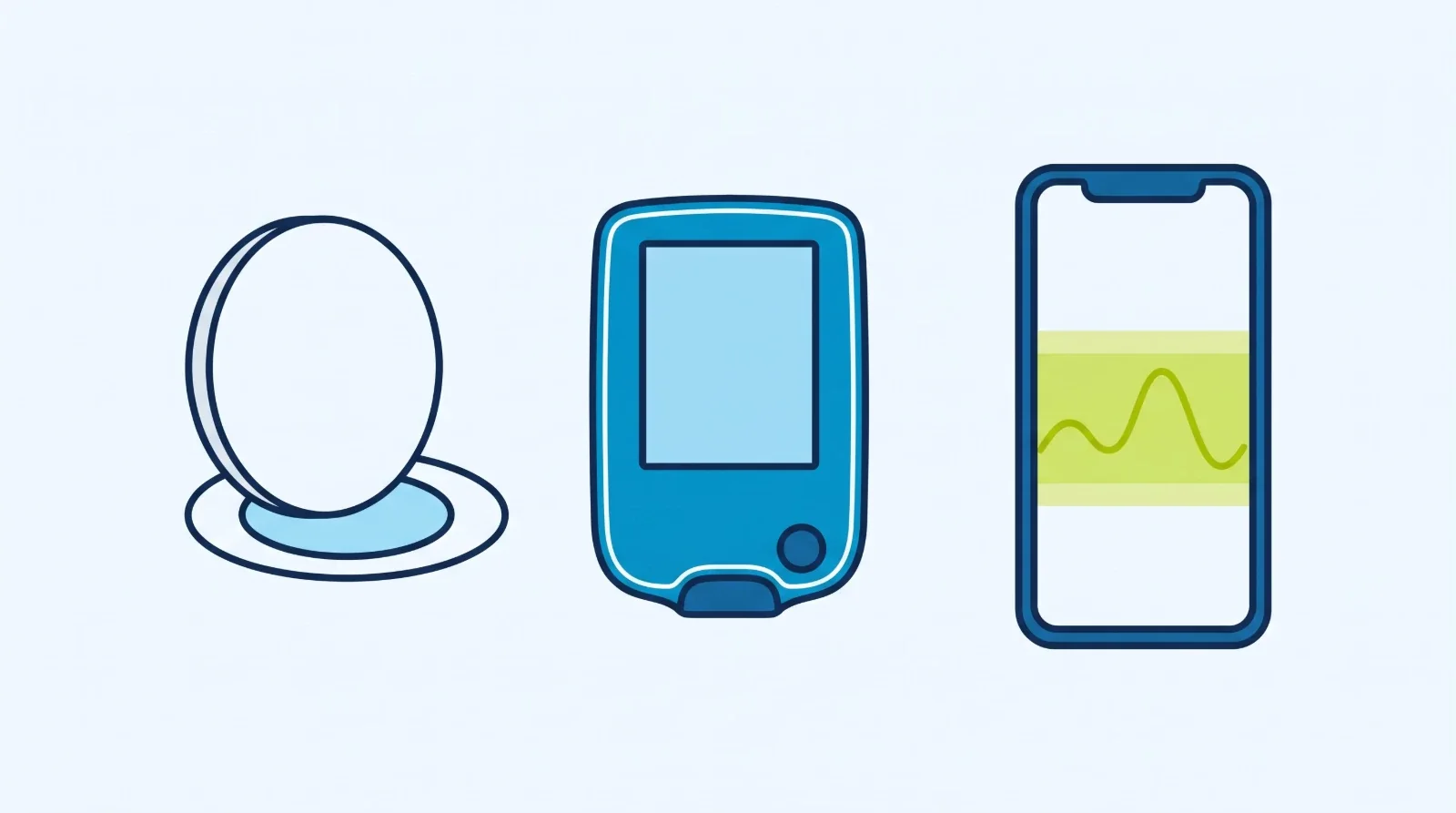
A finger prick tells you one number, at one moment, and tells you nothing about the six hours on either side of it. A glucose sensor sits on the back of your upper arm and reads the fluid under your skin every few minutes for about two weeks.
What you get back is not a number. It is a line. And the line answers questions a finger prick never can: what your sugar does overnight while you are asleep, what happens in the three hours after biryani, whether the morning reading is high because of dinner or because of something that happened at 4 am, and whether the tiredness at 5 pm is a low.
Most people who wear one for the first time change something about how they eat within a week, without being told to. Seeing your own line is more persuasive than any advice.
The rest of this section
- What rice, roti and biryani do to your line The one page written for the food actually eaten in this city, and the five things that change the shape of the curve. Portion, what is alongside it, the order you eat it in, and the twenty minutes afterwards.
- How to read the report you were handed The order a doctor reads it in: lows first, average last. What GMI is, why it will not match your HbA1c, and the five patterns most first reports show.
- Wearing one here, and knowing when it is wrong Keeping the adhesive on in 40-degree heat and monsoon humidity. Compression lows from sleeping on your arm. Airport security, MRI, exercise, and what to do if it fails on day four.
Who gets the most out of it
- Anyone on insulin, type 1 or type 2. This is the clearest case. It is the difference between adjusting a dose from guesswork and adjusting it from evidence.
- Type 1 diabetes, where it is close to standard care now, and essential if you have ever lost your warning symptoms of a low.
- Type 2 that will not settle despite tablets, where nobody can work out when the sugar is actually going up.
- Unexplained lows, especially at night, and especially if you live alone.
- Pregnancy and gestational diabetes, where the targets are tighter and the time to act is shorter.
- Newly diagnosed type 2, worn once, as a teaching tool. Two weeks of seeing your own response to your own food does more than a year of being told to avoid rice.
- Shift workers and people who fast, where the pattern is the whole problem. See also fasting with diabetes.
It is not only for people who are doing badly. Some of the most useful sensors we read belong to people whose HbA1c looks fine and whose line is swinging violently either side of it.
A sensor does not replace a finger-prick meter. You still need one to confirm a low and to check the sensor when it seems wrong. If you do not own a good one, see which glucometer to buy and how often to test.
What wearing one is like
Putting it on
It goes on the back of the upper arm with a spring applicator. It takes a second and most people describe it as less than a blood test. A fine filament sits under the skin; there is no needle left in you.
Living with it
You can shower, pray, sleep on it and go about your day. It is worn under clothing and is not visible in a shirt sleeve. There is a warm-up period of an hour or so before the first reading. You scan it with your phone, or it sends readings on its own, depending on which one you are using.
Coming off
It peels off after its wear period. You bring us the report, or share it from the app, and we go through it with you.
The practical detail (adhesive in this heat, bathing, two-wheelers, and the lows that never happened) is on wearing one here.
The four numbers that matter
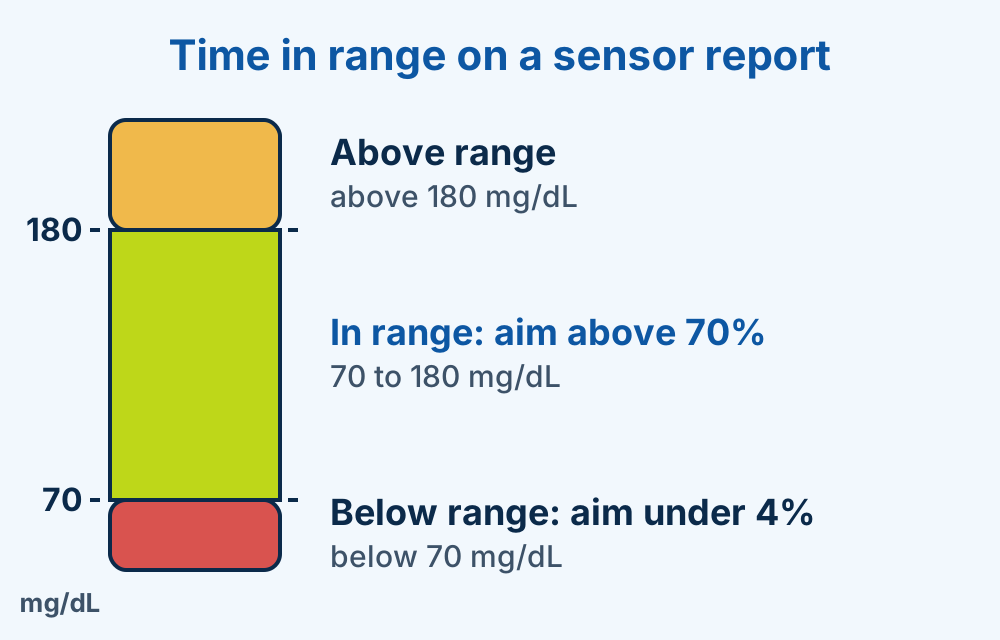
And they are not the average.
| What to look at | What it means | General target |
|---|---|---|
| Time in range | The share of the two weeks your glucose sat between 70 and 180 mg/dL. The single most useful number on the report. | Above 70% |
| Time below range | How much of the time you were under 70 mg/dL. Lows are more dangerous than highs in the short term, and most people do not feel all of them. | Under 4% |
| Variability | How far the line swings. A flat line at 150 is easier on you than a line bouncing between 60 and 250 that averages the same. | Lower is better |
| The overnight shape | What happens between midnight and waking. This is where the cause of a high morning reading actually lives. | Flat |
Targets are general, not yours. These are the international consensus figures for most non-pregnant adults with diabetes. If you are pregnant, elderly, frail, or have lost your warning symptoms of a low, your targets are different and looser targets may be the safer ones. That is a conversation, not a chart.
The full set of figures, what counts as enough data for a report to mean anything, and the order to read the panels in: how to read the report you were handed (or upload your sensor file to the report reader).
Insulin pump therapy
For people whose glucose cannot be controlled with injections, or whose lives do not fit a fixed injection schedule, a pump delivers insulin continuously through a small cannula, with extra given at meals. Set up and followed up here, with the sensor data read alongside it.
Pumps have a site of their own. Our type 1 diabetes site covers the MiniMed 780G closed-loop system in detail: how the automation works overnight, what it costs to run, and who it suits.
For questions about buying a pump, what it costs or a written quotation, call or WhatsApp Asad, who looks after insulin pumps for us, on +91 78937 89514.
A pump is a commitment, not an upgrade. It needs you to count carbohydrate, respond to alarms and change the site every few days. We will talk you through what it actually asks of you before anyone talks about buying one.
What it costs
Consultation ₹500. That includes fitting the sensor, and it includes going through the report with you afterwards. We do not charge a separate fee for reading it: a report nobody explains is not worth wearing a sensor for. A diet consultation with our dietitian is included alongside it at no extra charge.
Sensor prices change with brand, wear period and what is in stock. Call Caspian Pharmacy on +91 85198 41154 for the current price and availability. That is the number for cost and stock; reception on +91 89193 41154 is the number for appointments.
Laboratory tests (HbA1c, kidney function, lipids) are billed separately by our laboratory, Caspian Diagnostic Centre, which publishes its rates on its own site.
What a sensor will not do
- It will not dose your insulin for you. It shows you the line. Deciding what to change is still a clinical decision.
- It does not replace HbA1c entirely. The two answer different questions and we use both.
- It is not a diagnosis. Diabetes is not diagnosed from a sensor.
- It will not fix anything by itself. A sensor worn for two weeks and never discussed is an expensive way to feel worried.
- We will not tell you a sensor will lower your HbA1c by a specific amount. Anyone who does is guessing or selling.
If you are having a severe low (confused, unable to swallow safely, fitting or unconscious), that is an emergency. Call 108 or go to the nearest hospital with emergency facilities. There is no emergency department here.
Coming in
Bring any previous sensor reports, your glucose meter if you use one, and your current medicines. Mon–Wed, 9 am–1 pm and 3–9 pm. Thu–Sat, 3–9 pm. Sun closed.
Medically reviewed by Dr. Khizer Hussain Junaidy, Diabetologist & Bariatric Physician, Telangana State Medical Council 04937. General information for patients of Caspian Healthcare: your own doctor's advice comes first.