Why a diabetes clinic is doing this
Because a great deal of what does not get better here is this.
Sleep apnoea is found in somewhere between a third and two thirds of people with type 2 diabetes, depending on how hard anyone looks for it. Most of them do not know they have it. It is not a separate problem that happens to coexist; it actively works against everything else being done:
- Morning sugars that will not come down despite a sensible dinner and the right insulin. Repeated drops in oxygen overnight pour out stress hormones for hours, and the number you see at 7 am is the result.
- Blood pressure needing three or four tablets and still sitting high. In people with diabetes, having high blood pressure raises the odds of significant sleep apnoea several times over.
- Weight that will not shift on a diet that ought to be working, because broken sleep changes appetite and makes exercise unbearable.
- The tiredness that gets blamed on diabetes, on age, on work, for years.
Treating it is one of the few interventions that improves the morning reading, the blood pressure and how somebody feels at four in the afternoon, all at once. Which is why we would rather find it than keep adding tablets.
You probably need this test if
- You snore, and someone has seen you stop breathing. A witnessed pause is the single most useful thing a partner can report.
- You wake up unrefreshed after seven or eight hours, or with a headache or a dry mouth.
- You are sleepy in the day: dozing off watching television, in meetings, at traffic lights. The last one is not a joke and is a reason to be tested quickly.
- Your blood pressure needs three or more tablets and still is not controlled.
- Your morning sugar is the worst reading of your day and nothing you change at dinner alters it.
- You get up two or three times a night to pass urine and your kidneys and prostate have been checked and are fine.
- You have a large neck, or carry weight around the middle, or have atrial fibrillation, or have had a stroke.
You do not need a referral and you do not need to be our patient already. If you recognise yourself in three or more of those lines, the test is worth doing before another year goes by.
What actually happens
Getting the device
Call Raza on +91 78429 79411 and he will arrange it. The recorder is small, battery powered and comes with everything you need for one night.
The night
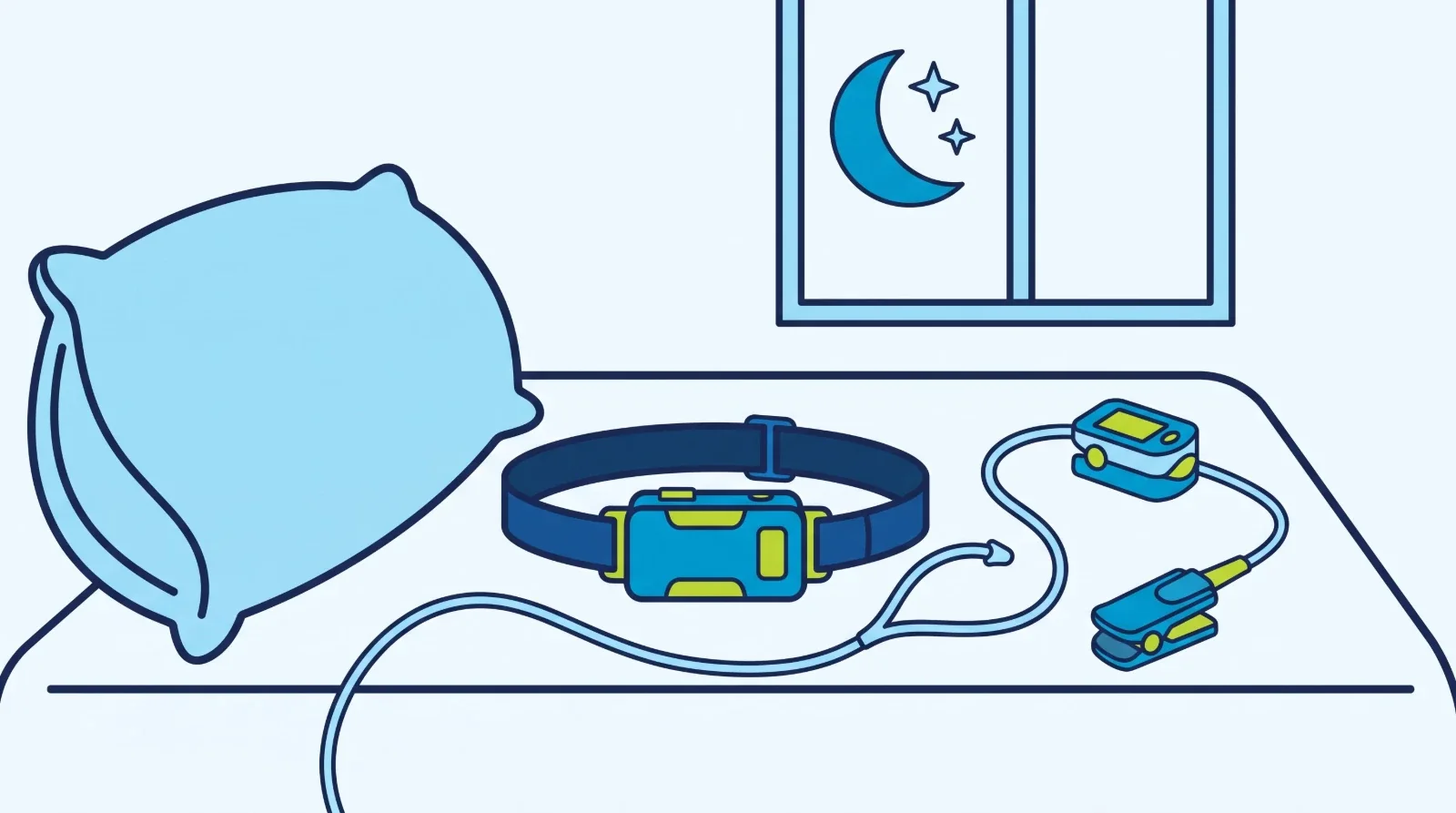
You wear it in your own bed at your usual bedtime. There is a soft tube at the nostrils that senses airflow, a band round the chest that senses breathing effort, and a clip on the fingertip that measures oxygen and pulse. It also records your position, because a lot of apnoea only happens on your back.
You sleep normally. You can get up in the night, and you can go to the bathroom without taking anything off. Nobody watches you and there is no wire to a machine in a hospital room, which is the reason most people sleep far more naturally than they would in a laboratory.
Afterwards
The device comes back and the recording is analysed. You get a consultation to go through what it found: what your AHI is, how far your oxygen fell and for how long, and whether position or alcohol is making it worse. That consultation is included in the price, not extra.
What it measures, and what the numbers mean
| What is recorded | What it tells us |
|---|---|
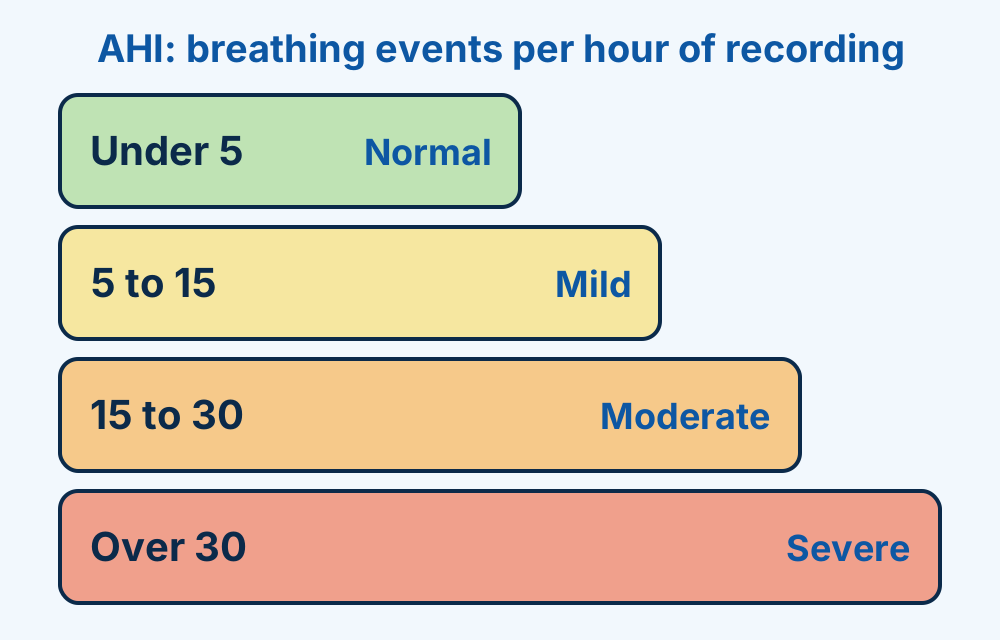
| AHI apnoeas and hypopnoeas per hour | The headline number. Under 5 is normal; 5 to 15 mild; 15 to 30 moderate; over 30 severe. It is how many times an hour your breathing stops or nearly stops. |
| Oxygen saturation | How far the oxygen in your blood falls with each event, and how much of the night you spent below normal. Two people with the same AHI can be in very different trouble here. |
| Pulse | The heart rate surges that follow each event. This is the part that drives blood pressure and, over years, the heart risk. |
| Body position | Whether it is happening only on your back. If it is, the first treatment may be far simpler than a machine. |
| Snoring | Volume and pattern, which corroborates the rest. |
What this test cannot do
A home study is a good test used in the right person. It is not the same as a full laboratory study, and pretending otherwise would be the easiest way to reassure somebody who should not be reassured.
- It does not measure sleep itself. There is no brainwave recording, so it cannot tell how much of the night you were actually asleep, or which stage you were in.
- It can underestimate how bad things are. The events get divided by the hours the device was recording, not the hours you slept. If you lay awake for two of them, your AHI comes out lower than the truth.
- A normal result does not always settle it. If the story is convincing and the test is normal or borderline, the right next step is a laboratory study, not relief.
- It only looks for one thing. It is a test for obstructive sleep apnoea. It does not diagnose narcolepsy, restless legs, or the many other reasons for sleeping badly.
A home test should not be your first test if you have significant heart or lung disease, weakness of the breathing muscles, have had a stroke, are on long-term opioids, or if central sleep apnoea is suspected. Those need a supervised laboratory study, and we will say so and refer you rather than sell you this one.
What it costs, and what the price includes
₹3,500. A sleep study done at home, in your own bed, with the report read by a pulmonologist.
| Included in the ₹3,500 | What that covers |
|---|---|
| The recorder, for one night | Arranged and brought to you with everything the night needs, and taken back afterwards. |
| The analysis | AHI, oxygen saturation, pulse, body position and snoring, scored from the night you recorded. |
| A pulmonologist's report | Read and reported by Dr. Mohammad Sameer Ahmed, MD Pulmonary Medicine. |
| The consultation afterwards | An appointment to go through the findings and settle what happens next. |
That is the whole fee for the test. If treatment turns out to be needed, what it involves and what it costs are worked out at that consultation rather than assumed here.
If it comes back positive
Nobody is handed a machine on the day. What happens depends on what the study showed and how you actually feel:
- Mild, and only on your back. Position training and weight loss first. A good number of people never need anything else.
- Moderate to severe, or sleepy in the day. CPAP is the treatment that works, and we will talk honestly about what wearing one is like before you buy or rent anything.
- Overweight with it, which is most people. This is where the rest of what we do joins up: weight treatment, including the newer medicines, changes sleep apnoea in a way little else does.
- Diabetes alongside it. Expect your morning readings to be re-examined once you are treated. That is the point of having found it.
We do not sell CPAP machines on commission and we are not tied to a supplier.
Who to see about this
Sleep apnoea splits into two questions and two different doctors answer them. Plenty of people end up seeing both, and reception can put the two appointments on the same evening.
The apnoea itself: Dr. Mohammad Sameer Ahmed
Pulmonologist, MD Pulmonary Medicine. He is the doctor who reads your study.
See him about what the recording showed, whether you need CPAP and how to get on with it, what to do when a home test comes back normal and the story does not, and whether a laboratory study is the right next step. Spirometry is done here if your breathing needs looking at as well.
Book with Dr. SameerThe weight behind it: Dr. Khizer Hussain Junaidy
Diabetologist & Bariatric Physician.
Most obstructive sleep apnoea is driven by weight, and weight is the only route by which it gets better rather than being managed with a machine for the rest of your life. See him about that, and about the morning sugars and the blood pressure that usually came along with it.
Book with Dr. KhizerIf you would rather not book online, reception on +91 89193 41154 is answered at any hour and will tell you who is in.
Arranging it
Call Raza on +91 78429 79411 for the device and the night it can be delivered. For anything clinical, or to be seen first, call reception on +91 89193 41154 or book online.
If you are falling asleep while driving, stop driving until you have been assessed. That is the one symptom on this page that is an emergency in slow motion.
If you would like to read more
Our Medical Director, Dr. Khizer Hussain Junaidy, has written a plain-language book on this: It's Not Just Snoring. It covers how sleep apnoea affects sugar, weight and the heart, and how it is tested and treated, with a foreword by Prof. Surendra K. Sharma. It is on Kindle at ₹189, free on Kindle Unlimited, and the opening chapters can be read free on Amazon. Reading it is entirely optional and makes no difference to your care here.
Medically reviewed by Dr. Mohammad Sameer Ahmed, Pulmonologist, TSMC/FMR/01466. General information for patients of Caspian Healthcare: your own doctor's advice comes first.