What it is
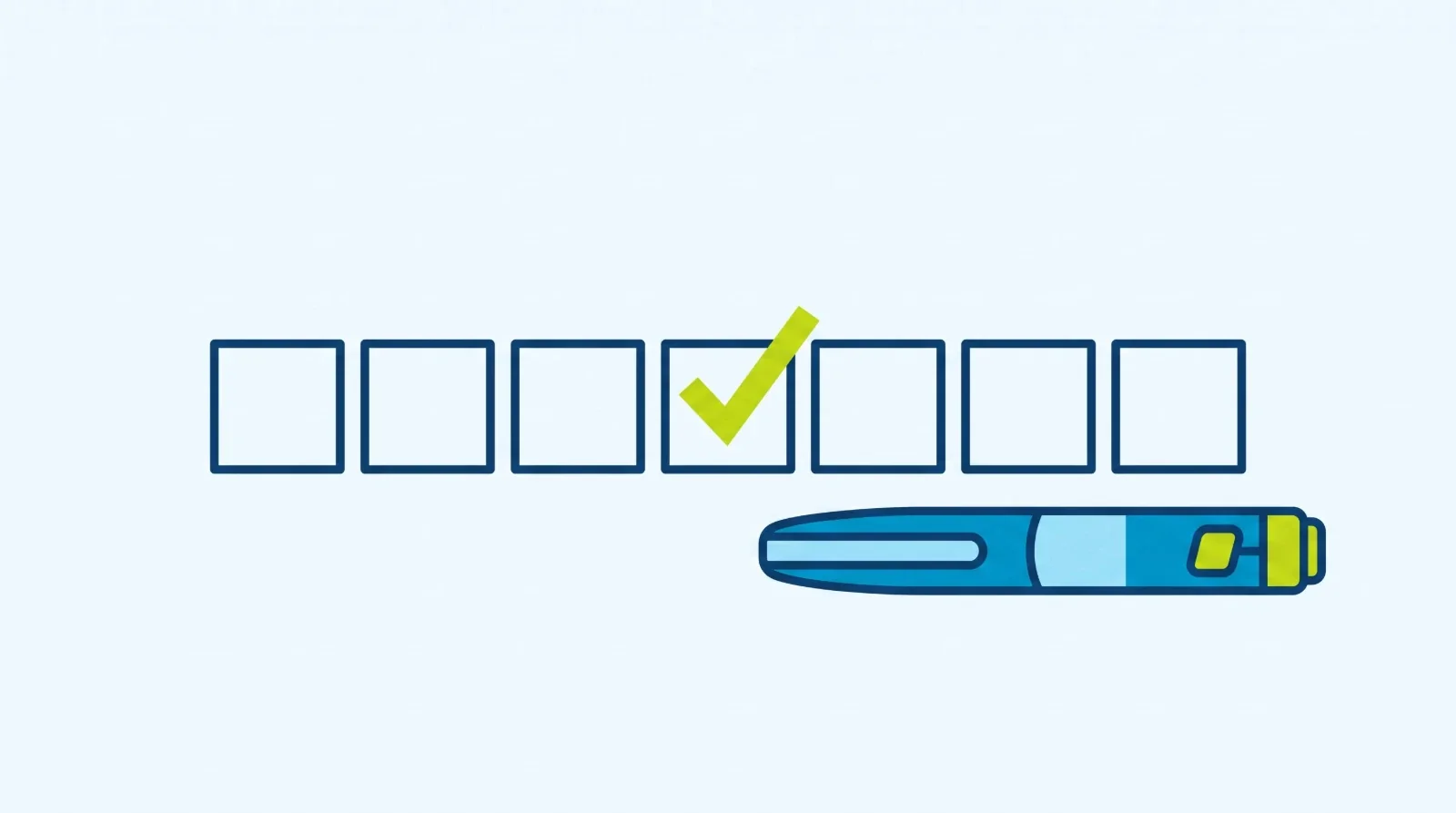
Awiqli is insulin icodec: a long-acting background insulin engineered to stay in circulation for about a week. One injection covers the seven days that seven injections used to.
Novo Nordisk brought it to India in July 2026, for adults with type 1 and type 2 diabetes. It comes as a prefilled pen, in two sizes.
It replaces your basal insulin, the one you take at bedtime or in the morning to cover you between meals and overnight. It does not replace mealtime insulin, and it does not replace your tablets.
Three hundred and sixty-five injections becomes fifty-two. For someone who has been injecting nightly for fifteen years, that is not a small convenience. It is the removal of a nightly reminder that they are ill.
What it costs, which is the surprising part
New usually means dearer. This does not.
| What | Detail | Price |
|---|---|---|
| A 70-unit week | A typical weekly dose, as one injection. | ₹261 |
| The same on daily basal | 70 units of the daily insulins it replaces, from the launch reporting. | ₹345–453 |
| 1 mL pen | 700 units. | ₹2,611 |
| 3 mL pen | 2,100 units. | ₹7,833 |
These are launch prices from July 2026 and your dose is not 70 units unless it is. Work out your own cost from your own dose, and treat the figures as indicative. The pen instructions also ask for a 10-unit flow check before every injection, so a 70-unit week really uses 80 units, about ₹298. You also use fewer needles, which is a small saving nobody counts.
Is a weekly basal insulin for you? In type 2 that is usually a straightforward conversation; in type 1 it is a considered decision, for the reasons set out above. Either way it belongs in a consultation. Book an appointment, or call reception on +91 89193 41154.
If you have type 1 diabetes, read this part twice
Awiqli is approved for type 1 and we will prescribe it for type 1. But the trial evidence in type 1 is not the same as in type 2, and you should decide knowing what it says.
| ONWARDS 6, type 1 diabetes | Weekly icodec | Daily degludec |
|---|---|---|
| HbA1c fall | 0.47% | 0.51% |
| Significant or severe lows per patient per year | 19.9 | 10.4 |
Roughly twice as many significant lows, for the same control of the average. That difference was real and not a chance finding.
In type 2 diabetes the rates were comparable. This is a type 1 finding.
What that means in practice is not "do not take it". It means that in type 1 this is a considered choice rather than an obvious upgrade, and that if you make it, you make it wearing a sensor, with alarms on, and with follow-up that is closer than usual for the first two months. If you live alone, or you have lost your warning symptoms of a low, that weighs heavily against it.
If you have type 2 diabetes and take a basal insulin, none of the above applies to you in the same way, and the decision is much simpler.
And if you are on an insulin pump, this is not for you at all: a pump delivers your background insulin continuously and there is no basal injection to replace. That is a different route to the same problem, and it is covered on our type 1 diabetes site.
The property nobody mentions
An insulin that lasts a week cannot be taken back.
A daily insulin that was too much is over by tomorrow. A weekly one that was too much is with you for days. That cuts both ways and it is worth understanding before you start:
- Dose changes take weeks to show their full effect, not days. Adjusting it is a slower, more patient business, and changing it yourself between reviews is a bad idea.
- Illness, fasting, a skipped day of eating: the insulin carries on regardless. Plans for those days need making in advance rather than improvised.
- Missing a dose matters more. One forgotten weekly injection is a forgotten week, not a forgotten night. Pick a day and anchor it to something you never miss.
Also plainly: switching from your daily insulin to this is a calculation, and it is ours to make, not yours. Do not stop your current basal and start this on your own.
Who it suits most
- Type 2 diabetes on basal insulin. The clearest case by a distance: same control, comparable lows, fewer injections, lower cost.
- Anyone whose injections are given by somebody else: an elderly parent injected by a son who works, a patient depending on a neighbour or a nurse. Seven visits a week becomes one.
- People who keep missing doses. The most common reason basal insulin fails is that it is not taken. One anchored day a week is far easier to keep than 365.
- People refusing to start insulin at all because of what daily injections would mean to their life. A weekly injection is a different proposition to argue with.
- Anyone travelling or working shifts, where a fixed nightly time was never realistic.
With Afrezza, this is the whole point
Take the two together and the arithmetic changes shape. A person with type 1 on a basal-bolus regimen injects something like five times a day; call it eighteen hundred injections a year. On weekly basal insulin with inhaled mealtime insulin, that is fifty-two injections and a breath at each meal.
Both are available here and both are on the Indian market now: inhaled insulin from Cipla and weekly insulin from Novo Nordisk. Neither has to be imported or waited for.
It is not for everyone, and the two cautions stack. Afrezza is ruled out entirely by asthma or COPD and needs a breathing test first. Weekly basal carries the higher low-sugar rate in type 1 described above. Someone for whom both are suitable is genuinely well served by the combination; someone for whom neither is suitable is better off on a good daily regimen, and we will say so.
If this is what you came for, book and bring your current insulin and your last three months of readings. It is a conversation worth having properly rather than in five minutes.
What it will not do
- It will not cover your meals. If you take mealtime insulin, you still take mealtime insulin: injected, or inhaled.
- It will not improve your control by itself. The trials matched HbA1c; they did not beat it. The gain here is in how you live, not in the number.
- It will not suit someone who cannot be followed up. A slow insulin needs patient, scheduled adjustment.
- It does not remove the need to measure. In type 1 it arguably increases it.
- We will not tell you it is better than your current insulin. For a lot of people it is simply more convenient at the same or lower cost, which is reason enough without overstating it.
If you are having a severe low (confused, unable to swallow safely, fitting or unconscious), that is an emergency. Call 108 or go to the nearest hospital with emergency facilities. There is no emergency department here.
Because this insulin lasts a week, a severe low needs to be reported to us even after you have recovered from it.
Coming in
Bring your current insulin pens or vials, your recent readings or sensor reports, and your other medicines. If somebody else gives your injections, bring them too: the decision affects their week as much as yours.
Mon–Wed, 9 am–1 pm and 3–9 pm. Thu–Sat, 3–9 pm. Sun closed.
Medically reviewed by Dr. Khizer Hussain Junaidy, Diabetologist & Bariatric Physician, Telangana State Medical Council 04937. General information for patients of Caspian Healthcare: your own doctor's advice comes first.