
For anyone who tests blood sugar at home with a glucometer.
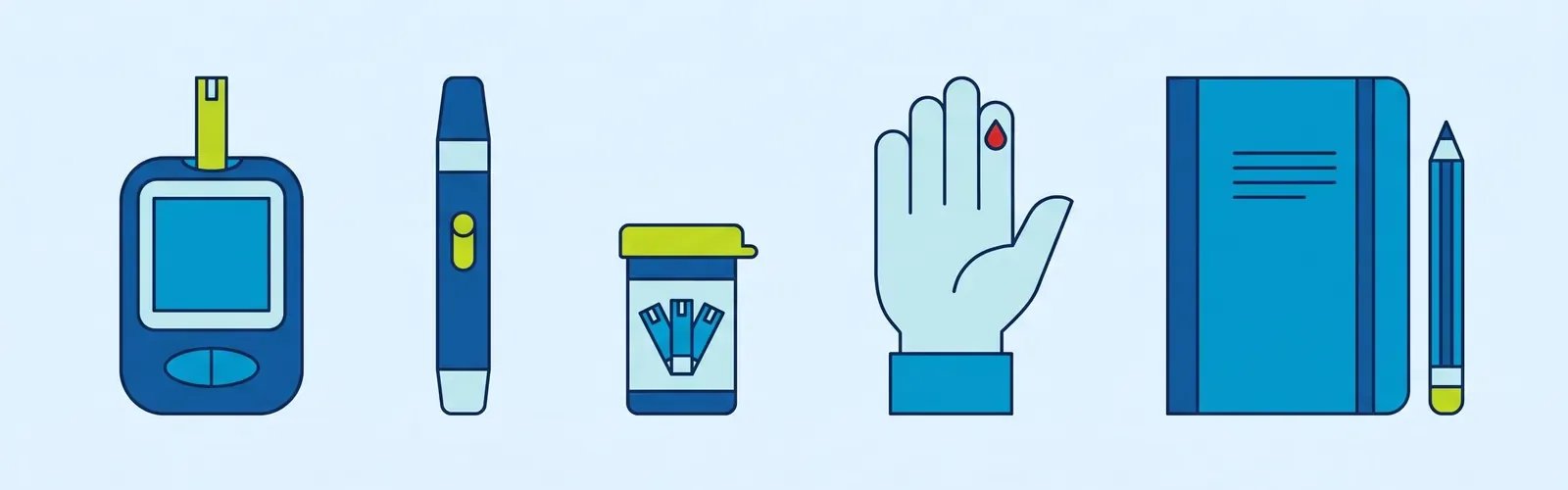
Fill in, then print
The test
- Wash your hands with soap and water and dry them well. Sugar from fruit or sweets on the finger gives a false high reading. Wet wipes and spirit are not a substitute.
- Put a strip into the meter. Close the strip bottle at once.
- Prick the side of a fingertip, not the pad. Use a different finger each time. Avoid the thumb and the index finger.
- Let a drop form. Do not squeeze hard. Warm hands bleed more easily.
- Touch the drop to the strip and wait for the result.
- Write the result down with the date and time, or let the meter store it.
- Put the used lancet and strip into a closed, hard container.
When to test
Test at the times your doctor has marked above. Common times are:
- Before breakfast (fasting)
- 2 hours after the first bite of a meal
- At bedtime
- At 3 am, if night-time lows are suspected
- Any time you feel low or unwell
- Before driving, if you take insulin or a tablet that can cause low sugar
Usual targets for adults
| When | Target (mg/dL) |
|---|---|
| Before meals | 80 to 130 |
| 2 hours after the start of a meal | below 180 |
These are the American Diabetes Association goals for most adults. Your doctor may set different targets for you, for example in pregnancy, in old age or if you get lows.
Why a reading can be wrong
- Unwashed or wet fingers
- Strips past their expiry date, or kept in an open bottle, in heat or in humidity
- Too small a drop
- Severe dehydration or severe anaemia
- A meter and a laboratory can differ by up to about 15 per cent. That is expected.
If the number does not match how you feel, wash your hands and test again. If you feel low, treat it first. Bring your meter and your record to every visit.
Act on these readings
- Below 70: treat it as low sugar straight away. See the low sugar sheet.
- The meter shows HI, or the reading is above the limit your doctor gave you: wash your hands, test again, and call the doctor the same day. If you are also vomiting, drowsy or breathing fast, go to a hospital.
Looking after the meter
- Use only the strips made for your meter.
- A lancet is for one use by one person. Never share a lancing device.
- Keep the meter and strips out of direct sun and away from the kitchen and bathroom.
Questions about this sheet? Call Caspian Healthcare reception on +91 89193 41154. A doctor is on duty at all hours for problems that are not critical. Caspian has no emergency department: in an emergency call 108.
Where this comes from
- American Diabetes Association: checking your blood sugar
- US Food and Drug Administration: blood glucose monitoring devices
- Diabetes UK: checking your blood sugar levels
Prepared by Caspian Healthcare from the sources above. Last reviewed October 2026. General information: your own doctor's written instructions come first.