Home Glucometer: Which One, and How Often
A meter is the one piece of equipment most people with diabetes own, and most buy it on the strength of a shop recommendation. This page tells you what actually matters in one, names the meter Dr Khizer uses himself, and gives you a testing pattern to start from. Our pharmacy stocks it and will set it up with you.
What a home meter tells you that the HbA1c cannot
The HbA1c is an average over three months. It cannot tell you that your sugar is 62 at 3 am, that it climbs to 240 after biryani, or that a new tablet is working by the second week. A meter can, and those are the readings that change a dose.
For anyone on insulin or on a tablet that can cause a low, a meter is not optional. It is the only way to confirm that a shaky, sweaty feeling is a low before you treat it, and the only way to know you are safe to drive.
What matters in a meter
Six things, in the order to weigh them. Brand and colour are not on the list.
Accuracy you can check
Look for ISO 15197:2013 on the box. That standard asks a meter to be within 15 per cent of the laboratory on at least 95 per cent of readings. Then check it yourself: test on your meter at the same time as a lab sample and compare.
Strip cost and supply
The meter is cheap. The strips are the real cost, every month, for years. Before you buy, ask the price of a box of 50 strips and whether the pharmacy near you keeps them in stock.
A small drop of blood
A meter that needs 0.5 to 1 microlitre lets you prick less deep and reuse a sore finger less often. Older meters needing a big drop are the ones people stop using.
A strip that is easy to fill
A wide dosing edge that pulls blood from any side means fewer wasted strips and fewer error messages, which matters most for older hands and poor eyesight.
A screen you can read
Large digits and a backlight. Many of our patients test at 3 am or before dawn in Ramzan, in the dark, without glasses on.
Memory, and a way to show us
The meter should store readings with date and time. Bluetooth to a phone app is useful but not essential: a notebook brought to every visit does the same job.
The meter Dr Khizer uses: the Accu-Chek Guide
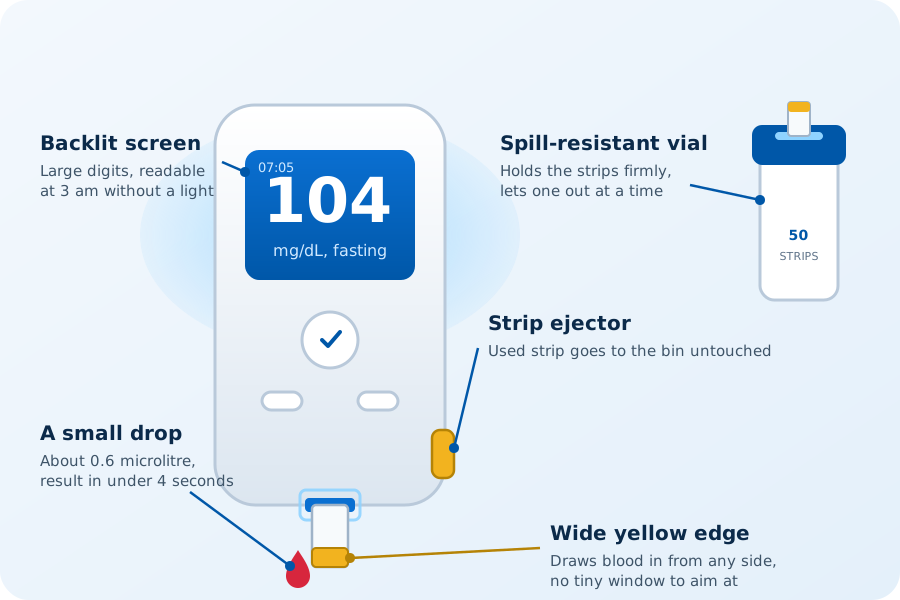
Dr Khizer Hussain Junaidy, our Diabetologist & Bariatric Physician, uses the Accu-Chek Guide himself and recommends it in clinic. It is made by Roche, it meets ISO 15197:2013, and it does the six things above well. These are the features that decide it in daily use.
Spill-resistant strip vial
The strips sit in a vial that holds them in place and lets one out at a time, so a handbag or a bedside drawer does not end in strips on the floor.
Wide strip edge
Blood is drawn in from any point along a broad yellow edge. You do not have to aim the drop at a tiny window.
Small drop, fast result
It needs about 0.6 microlitre and reads in under four seconds. Less squeezing, less waiting with a bleeding finger.
Backlit screen and a lit strip port
Both the display and the strip slot light up, which is what makes a night-time or pre-dawn test possible without switching on a room light and waking the house.
Strip ejector
A button pushes the used strip out into the bin, so nobody handles a strip with blood on it.
Phone app, if you want it
Bluetooth to the mySugr app logs every reading automatically and can send a report to us before a visit. The meter works just as well without the app.
Two things to be clear about. This is a doctor's personal recommendation, not a verdict on other meters: any meter that meets ISO 15197:2013 is acceptable, and if yours works, keep it. And no manufacturer asked for this page or paid for it. We stock the meter because we recommend it, not the other way round.
One thing to get right at the shop. The Guide takes only Accu-Chek Guide strips. The Active and Instant strips from the same company look similar and do not fit. Say "Guide strips" when you buy.
Buying it here
Caspian Pharmacy, in this building, keeps the Accu-Chek Guide meter, its strips and lancets in stock, and is open at every hour. For the current price, call the pharmacy counter directly rather than reception.
When you buy it here, the pharmacy staff set the date and time, take the first reading with you, and show you how to load the vial and eject a strip. Bring the meter to your consultation and test on it at the same time as our own sugar check, so you know how your meter compares with ours.
How often to test
A meter used at random tells you nothing. A meter used at set times tells you where the problem is. Start from the pattern that fits you, and let your doctor change it: the printable instruction sheet has boxes for the doctor to tick the times.
| Your situation | A pattern to start from |
|---|---|
| Tablets only, sugars stable | Two or three days a week: fasting, and two hours after one main meal. Rotate the meal. |
| On a once-daily basal insulin | Fasting every morning, because that number is what your dose is adjusted on. Add a bedtime reading if you get night lows. |
| On insulin with every meal | Before each meal and at bedtime, four times a day. Add 3 am if a morning reading is unexpectedly high or low. |
| Pregnant | Fasting and one or two hours after every meal, as your obstetric plan says. Usually four to seven times a day. |
| Unwell, vomiting or fever | Every four hours, including at night, until you are eating normally again. See the sick day sheet. |
| Before driving, if you take insulin or a sulfonylurea | Once, before you start. Do not drive below 90. |
Pair your readings: a fasting number alone says little, but fasting and two hours after the same meal, on the same day, tell us whether the meal or the night is the problem.
What the number should be
| When | Usual target for adults |
|---|---|
| Before meals (fasting) | 80 to 130 mg/dL |
| Two hours after the start of a meal | below 180 mg/dL |
| Any time | never below 70 mg/dL |
These are the American Diabetes Association goals for most adults. Your doctor may set different ones, for example in pregnancy, in old age, or if you get lows.
Below 70, or the meter shows LO
Treat it as a low straight away, before anything else. Fifteen grams of sugar, wait fifteen minutes, test again. The low sugar sheet has the steps. Above the limit your doctor gave you, or HI on the screen: wash your hands, test again, and call us the same hour. If you are also vomiting, drowsy or breathing fast, come in. A doctor is here at every hour.
Strips, lancets and the meter
Close the vial the moment a strip is out. Hyderabad humidity spoils an open vial of strips long before the printed date. Keep the meter and strips away from the bathroom, the kitchen and direct sun, and out of a parked car.
A lancet is for one use by one person. Change it every time; a blunt lancet is why fingers hurt. Used lancets are needles and never go in the household bin: our pharmacy counter gives you a hard container for them at no charge and takes the full one back.
Once a year, or whenever a reading does not match how you feel, compare the meter with our laboratory. Test on your meter at the moment the sample is drawn. Up to about 15 per cent apart is expected; more than that, bring the meter in.
Questions people ask
Which glucometer does Dr Khizer recommend?
The Accu-Chek Guide. He uses it himself and recommends it in clinic because the strips are easy to fill, the screen is backlit, and the vial does not spill. Caspian Pharmacy stocks the meter and its strips. Any meter that meets ISO 15197:2013 is acceptable, so do not throw away a working meter just because of this page.
Is a glucometer as accurate as the laboratory?
No, and it is not meant to be. A good meter is allowed to differ from the laboratory by up to about 15 per cent. A meter is for spotting patterns and lows at home. Diagnosis and the HbA1c are done in the laboratory.
Can I use any strip in my meter?
No. Strips are made for one meter. The Accu-Chek Guide takes only Accu-Chek Guide strips; the Active and Instant strips from the same company do not fit it. Buying the wrong box is the most common wasted purchase we see.
How long do strips last after the vial is opened?
Check the printed expiry date, and close the vial straight after taking a strip out. Strips left open in Hyderabad humidity read wrongly long before the expiry date. Never keep them in the bathroom or near the stove.
Do I need the Bluetooth and the phone app?
No. The app is convenient for people who like it and useful for sending us a report before a visit. A notebook with the date, time and reading does the same job, and a meter stores readings on its own.
Can my family share one meter?
The meter, yes, as long as each person uses their own lancet and the readings can be told apart. The lancing device is better not shared, and a lancet is for one use by one person.
What does HI or LO on the screen mean?
HI means the reading is above what the meter can measure, usually over 600 mg/dL. LO means below what it can measure, usually under 20. Both are emergencies. Treat LO as a severe low straight away, and for HI call us the same hour, especially if you are vomiting, drowsy or breathing fast.
Where do used strips and lancets go?
Lancets are needles. Put them in a hard, closed container, never in the household dustbin. Our pharmacy counter gives you a container for them at no charge and takes the full one back. Used strips can go in ordinary waste.
Is a glucose sensor (CGM) better than a glucometer?
They do different jobs. A sensor shows the whole day's line for two weeks and is the right tool when the pattern is the problem. A glucometer gives one number now, costs far less, and is the tool for confirming a low, checking a sensor when it seems wrong, and routine monitoring for most people on tablets.
Will you set the meter up for me?
Yes. Buy it at our pharmacy and the staff will set the date and time, show you the first test and check your technique. Bring the meter to your consultation and we will compare it with our own reading the same day.
Medically reviewed by Dr. Khizer Hussain Junaidy, Diabetologist & Bariatric Physician, Telangana State Medical Council 04937. Accu-Chek is a trademark of Roche. This page is general information for patients of Caspian Healthcare and does not replace your own doctor's advice.
Need to see a doctor?
Tell us what you need and we will call you back, or ring us now. Someone answers at any hour, and if we are not the right place for your problem we will tell you that.