Why the target is what it is
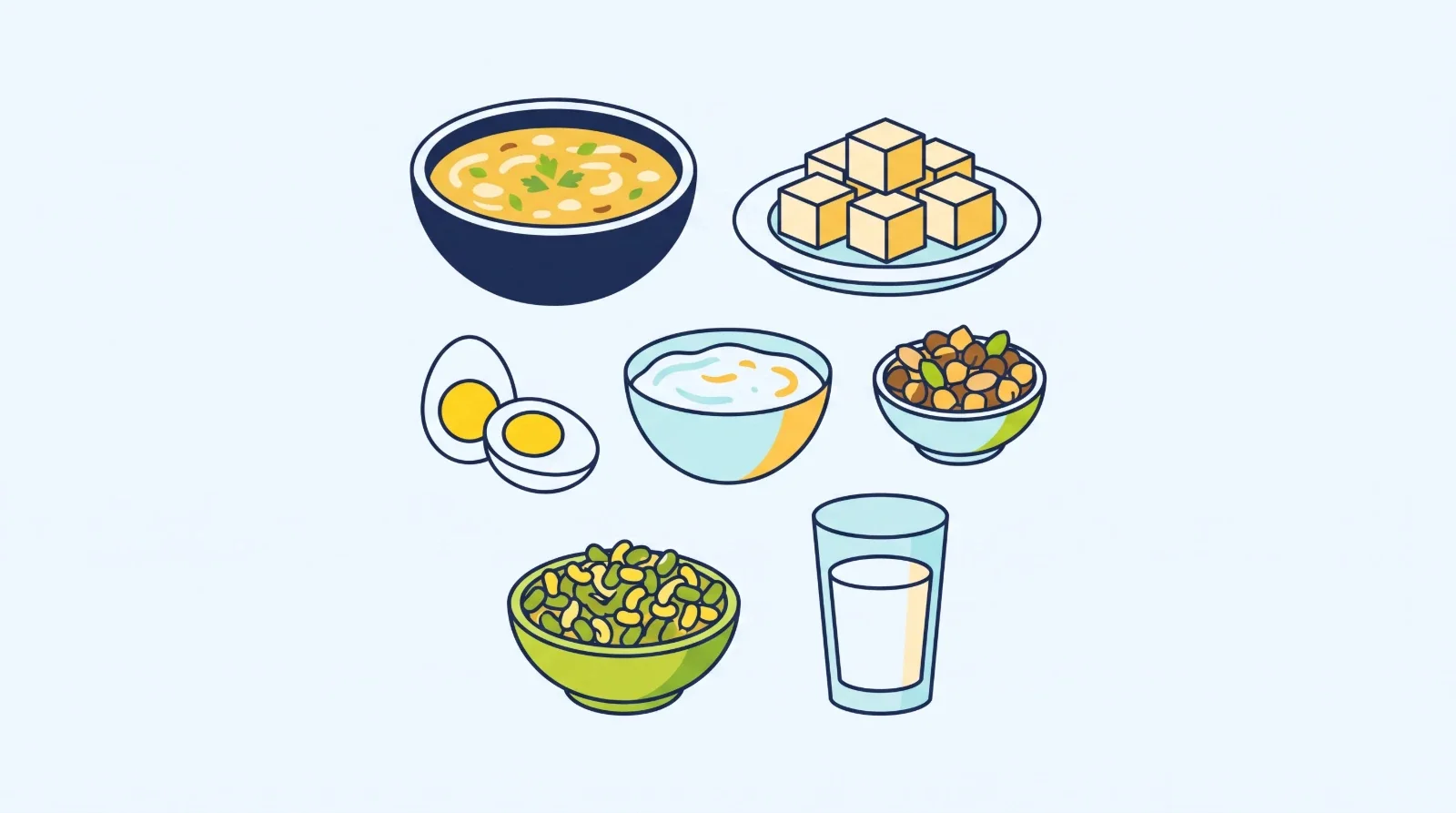
The 2025 joint advisory from the American College of Lifestyle Medicine, the American Society for Nutrition, the Obesity Medicine Association and The Obesity Society notes that targets of 1.2 to 1.6 g of protein per kilogram of body weight per day have been proposed during active weight loss. It also says it is unclear which body weight to use for people with obesity, because actual weight can overestimate the need. It mentions a simple fixed target of 80 to 120 g a day as another option.
The tool above uses 1.2 to 1.6 g per kilogram. If your BMI is under 25, it uses your actual weight. If your BMI is 25 or more, it uses an adjusted body weight: your ideal weight for your height (Devine formula), plus 40% of the difference between your actual weight and your ideal weight. The advisory does not settle this, so this is our choice. If you are doing serious resistance training, aim at the upper end.
The counterintuitive part. Appetite suppression makes protein harder to eat at exactly the moment it matters most. A vegetarian patient eating 900 calories a day because they are not hungry will not reach the target by accident. It has to be deliberate, and it usually has to be planned by somebody.
Three rules that do most of the work
- Protein goes in first, at every meal Your stomach only takes a small volume now. Whatever goes in first is what you actually get. If the rice goes in first, the dal does not. Eat the dal, the curd, the paneer, the egg or the fish before you touch the roti or the rice. This single reordering, changing nothing else, moves most people twenty grams a day.
- Two or three anchors, not one big one One large protein meal a day does not work when you cannot eat a large meal. Spread it: something at breakfast, something at lunch, something in the evening.
- Liquid protein counts and is easier Milk, chaas, a sattu drink, a thin dal drunk from a glass, curd, a whey shake. On the days when solid food is unappealing, this is how the target gets met at all.
The cheapest way to get there
Protein has a reputation for being expensive and it does not have to be. Ranked by protein per rupee, the best options in an Indian kitchen are, in order: soya chunks, which are far ahead of everything else at roughly 3 g of protein per rupee, then eggs, groundnuts, chana and dal. Whey protein is convenient and is nowhere near the top of the list on cost.
Thirty grams of dry soya chunks, which costs about five rupees, carries fifteen grams of protein. That is more than two eggs and roughly the same as a hundred grams of paneer costing eight times as much.
If you are vegetarian
- Dal alone will not do it. A katori of dal has about six grams of protein, so reaching sixty grams on dal alone means ten katoris.
- Combine through the day rather than at each meal: cereal proteins and pulse proteins complement each other across a day, so the traditional dal-chawal and rajma-roti pattern is sound as long as the quantities are there.
- Curd and paneer are your densest everyday options, and both are permitted during most vrat fasting.
- Get B12 checked and expect to supplement it. This is not optional on a vegetarian diet during weight loss.
If you are Jain
Root vegetables and sprouts are out, which removes some options but not the important ones. Dal, paneer, curd, milk, soya, groundnuts, besan and tofu are all available and between them are more than enough. The tool above filters to what is permitted.
Source: Nutritional priorities in obesity treatment, joint advisory of the American College of Lifestyle Medicine, the American Society for Nutrition, the Obesity Medicine Association and The Obesity Society, published in Obesity and the American Journal of Clinical Nutrition, 2025. Protein values from standard Indian food composition data.