Walk-In Injection Room, Open 24 Hours
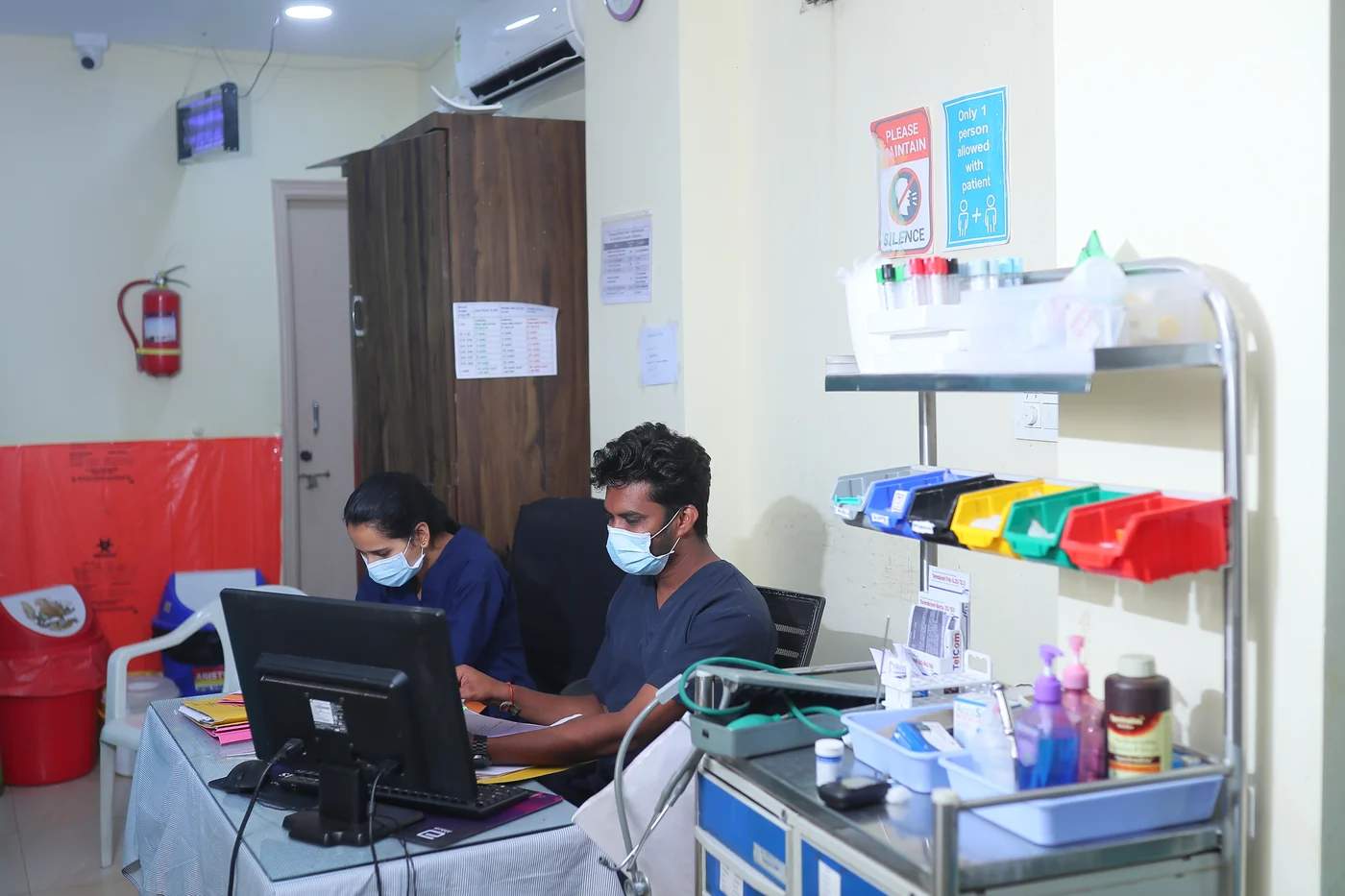
Nurses are on the premises 24 hours a day, seven days a week. Bring a valid prescription and the injection is given when you arrive. There is no appointment, and nothing that has to wait until morning. Giving an intramuscular or subcutaneous injection costs ₹50. The medicine is billed separately.
What this service is
A doctor writes up a course of injections, and the problem immediately becomes where to have them given. Most places that give injections keep clinic hours, so a dose due late at night, or on a Sunday, or at three in the morning, waits until somebody opens.
This one does not close. Nurses are here at every hour of every day, and so is a doctor. Walk in with the prescription and the injection is given while you wait. If you are already holding the course, bring it and we will check it first. If you are under treatment here, the medicine comes from the pharmacy in the same building, and that is set out further down.
What is given is an intravenous push, an intravenous infusion of 100 ml or 500 ml, a subcutaneous injection or an intramuscular injection. What each of those costs to administer is set out below, and it is the same figure at four in the afternoon and four in the morning.
What it costs to give the injection
These are administration charges. They pay for a nurse giving the injection, and for nothing else.
| What is given | Examples | To administer |
|---|---|---|
| Intravenous push, up to two injections | Pantoprazole, ondansetron | ₹50 |
| Intravenous infusion, 100 ml | Intravenous ferric carboxymaltose, an antibiotic made up in 100 ml | ₹100 |
| Intravenous infusion, 500 ml | Normal saline, Ringer lactate | ₹300 |
| Subcutaneous injection | Insulin, a GLP-1 | ₹50 |
| Intramuscular injection, up to two | Neurokind Gold, Dynapar | ₹50 |
The medicine is not in these figures. It is billed separately, whether it is dispensed here or you arrived holding the course already. If you want the total before anything is given, ask at the counter and you will be told.
Up to two is on the intravenous push row and on the intramuscular row, and it means what it says: two injections at that visit for the one charge. There is no published figure for a third, because the practice has not set one. Ask, and you will be told before it is given rather than after.
An infusion that runs for hours and needs you lying on a bed is a different service. That is day care, and it is charged as day care.
Who comes here for this
Four situations account for most of it.
A course of injections after surgery somewhere else
You were operated on at another hospital and came home with intravenous antibiotics still to finish. The course has to be given on time and it has to be near where you live. Bring the discharge summary and the prescription and it can be finished here, at whatever hour suits you.
Anybody who cannot inject themselves
Insulin, including a once-weekly one, and the weekly weight-loss injections. Some people never get on with the pen, and it is commonest in the elderly and in anybody who has just been started on one. A nurse doing it takes a minute and costs ₹50.
Vomiting, at an hour when nothing is open
Somebody who cannot keep water down needs an anti-emetic now, not at nine tomorrow morning. An intravenous push is ₹50 to give, and a doctor is here to look at you first if the nurse thinks you should be seen.
Fluids for dehydration
Normal saline or Ringer lactate, 500 ml, ₹300 to run. If it is going to take most of an afternoon and you need to lie down for it, that is day care rather than this.
If you are on one of the treatments below and the needle is the part you dread, this is the service that answers it. The longer infusions, and the ones that need a bed, are on the day care page.
WEEKLY INSULIN (AWIQLI)WEIGHT-LOSS INJECTIONSDAY CARE INFUSIONS
Bring the prescription
Bring a valid prescription for what you want given, and bring the medicine itself if you are already holding it. Where the medicine comes from depends on whether you are under treatment here, and that is set out under the next heading.
An injection is not given on request. If you arrive without a prescription and ask for something by name, the answer is no, and it stays no however the request is put. This is not paperwork the counter can waive. An injection goes somewhere it cannot be taken back from, and a nurse giving one on request has no way of knowing what else you have taken, what you react to, or what the injection is supposed to be treating.
Where the nurse or the duty doctor thinks you should be seen before anything is given, you will be seen first. A doctor is on the premises at every hour, so being seen first costs you a few minutes rather than a day. That is the difference between running a walk-in injection room safely and running one recklessly.
We publish no list of drugs we will not give, and we are not going to. A list invites the reading that anything missing from it will be given. The rule is the prescription and the doctor, and it applies to everything.
Where the medicine comes from
One question settles it. Are you under treatment at Caspian, or have you come in only to have an injection given?
If you are under treatment here, whether you are admitted to a bed or you have been seen in our clinic and are on a course we are running, the medicine comes from the pharmacy in this building.
If you are not under treatment here, and have walked in to have something given on another doctor's prescription, bring what you have and we will check it before it is given. An insulin or weight-loss pen you keep at home is yours to buy where you like. This rule is about a course being given here.
The reason for the first rule is money, and we would rather set it out than dress it up. A ward bed here is ₹3,500 a day and a cubicle is ₹4,500, and that is the whole bed charge. It is set at that figure because the pharmacy and the laboratory are part of how an admission is funded. Nothing is sold above the printed MRP, which is on the box you are handed, and the margin involved is the ordinary trade margin on the pack. If the bed is taken at that rate and the medicines and the tests are bought elsewhere, the arithmetic stops working, and the bed charge is the first thing that would have to rise. We would rather write that down than put the bed charge up and say nothing about why.
Alongside that there is the ordinary practical case. Somebody finishing a course of intravenous antibiotics prescribed at another hospital is already holding the medicine, and turning them away would be absurd. So what you bring is checked and given, and nothing here is a refusal to use medicine you already own.
What we need to see before we give it. The medicine in its sealed original pack, with the label readable. Anything that has to stay cold, which includes insulin and the weekly weight-loss injections, kept cold on the way here, and we will ask how you carried it.
We will not give an injection from a broken seal, from a syringe somebody else has already drawn up, or from a vial we cannot identify. That is not a rule about where you bought it. It is that once a thing is in a vein it cannot be taken back, and the person holding the needle has to be able to account for what is in it.
An injection is not the answer to an emergency
If you have chest pain, sudden weakness or difficulty speaking, heavy bleeding, unconsciousness, or a seizure that will not stop, call 108 or go to the nearest hospital with emergency facilities. Do not spend that time coming here for an injection.
Nursing for admitted patients
The injection room is not all of it. Patients admitted to one of our inpatient beds are looked after by the same nursing staff through the night: observations, the medicines their consultant has written up, and the ordinary practical work of looking after somebody too unwell to do it for themselves. A doctor is on the premises at every hour for them as well.
That is a real service and it is worth stating plainly, but it is not what most people arrive at this page for. What we admit for, what we do not have, and what a bed costs a day are all on the inpatient page.
If you are not sure whether we can give what you have been prescribed, call before you travel.
Need to see a doctor?
Tell us what you need and we will call you back, or ring us now. Someone answers at any hour, and if we are not the right place for your problem we will tell you that.